
Join Our JEE Preparation Group
Prep with like-minded aspirants; Get access to free daily tests and study material.
Sign in
Please select an account to continue using cracku.in
↓ →
Join Our JEE Preparation Group
Prep with like-minded aspirants; Get access to free daily tests and study material.
An electron, moving along the x-axis with an initial energy of 100 eV, enters a region of magnetic field $$\vec{B} = (1.5 \times 10^{-3}$$ T)$$\hat{k}$$ at S (see figure). The field extends between x = 0 and x = 2 cm. The electron is detected at the point Q on a screen placed 8 cm away from the point S. The distance d between P and Q (on the screen) is:
(electron’s charge $$1.6 ×10^{−19} C$$, mass of electron $$=9.1×10^{−31} kg$$)
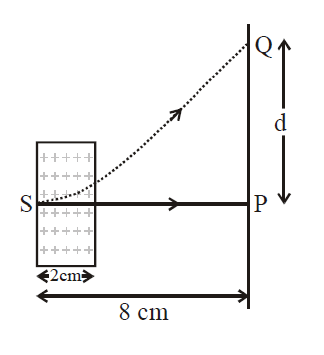
Given: $$K = 100\text{ eV} = 100 \times 1.6 \times 10^{-19}\text{ J}$$, $$B = 1.5 \times 10^{-3}\text{ T}$$, $$x = 2\text{ cm} = 0.02\text{ m}$$, $$L = 8\text{ cm} = 0.08\text{ m}$$
$$R = \frac{\sqrt{2mK}}{qB} = \frac{\sqrt{2 \times 9.1 \times 10^{-31} \times 1.6 \times 10^{-17}}}{1.6 \times 10^{-19} \times 1.5 \times 10^{-3}} = \frac{5.4 \times 10^{-24}}{2.4 \times 10^{-22}} = 0.0225\text{ m} = 2.25\text{ cm}$$
$$\sin\theta = \frac{x}{R} = \frac{2}{2.25} = \frac{8}{9}$$
$$\tan\theta = \frac{\sin\theta}{\sqrt{1 - \sin^2\theta}} = \frac{8/9}{\sqrt{17}/9} = \frac{8}{\sqrt{17}}$$
Total horizontal distance from the exit point of the magnetic field to the screen: $$x' = L - x = 8 - 2 = 6\text{ cm}$$
Total vertical deflection ($$d$$) split into curved region ($$d_1$$) and straight region ($$d_2$$):
$$d_1 = R(1 - \cos\theta) = R\left(1 - \frac{\sqrt{17}}{9}\right) = 2.25 \times \left(1 - \frac{4.123}{9}\right) = 2.25 \times 0.5419 = 1.22\text{ cm}$$
$$d_2 = x'\tan\theta = 6 \times \frac{8}{\sqrt{17}} = \frac{48}{4.123} = 11.64\text{ cm}$$
$$d = d_1 + d_2 = 1.22 + 11.64 = 12.86\text{ cm} \approx 12.87\text{ cm}$$
Was this solution helpful?
Create a FREE account and get:
_1.webp)

Educational materials for JEE preparation

Ask our AI anything

AI can make mistakes. Please verify important information.
AI can make mistakes. Please verify important information.


