
Join Our JEE Preparation Group
Prep with like-minded aspirants; Get access to free daily tests and study material.
Sign in
Please select an account to continue using cracku.in
↓ →
Join Our JEE Preparation Group
Prep with like-minded aspirants; Get access to free daily tests and study material.
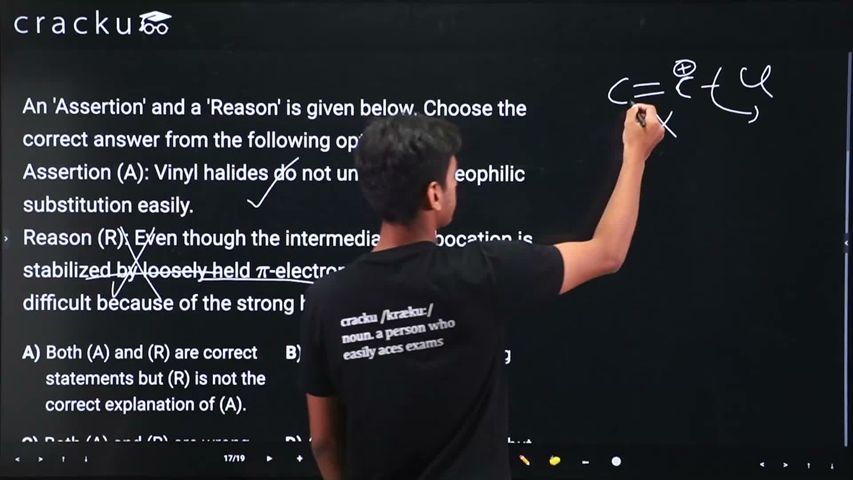
An 'Assertion' and a 'Reason' is given below. Choose the correct answer from the following options:
Assertion (A): Vinyl halides do not undergo nucleophilic substitution easily.
Reason (R): Even though the intermediate carbocation is stabilized by loosely held $$\pi$$-electrons, the cleavage is difficult because of the strong bonding.
We have to check two separate things - first, whether the assertion about vinyl (alkenyl) halides is true, and second, whether the given reason is itself true and whether it really explains the assertion.
Vinyl halide means a molecule in which the halogen atom is directly attached to an $$\mathrm{sp^2}$$-hybridised carbon atom of a carbon-carbon double bond, for example $$CH_{2}=CH-Cl$$. Let us recall the two main nucleophilic substitution pathways:
1. $$\mathrm{S_N1}$$ mechanism 2. $$\mathrm{S_N2}$$ mechanism
For an $$\mathrm{S_N1}$$ process, the first step is:
$$R-X\; \longrightarrow \; R^{+ + X^{-}}$$
That is, heterolytic cleavage of the C-X bond to give a carbocation. The stability of the intermediate carbocation determines whether this step is easy or difficult. A vinyl carbocation would look like
$$CH_{2}=CH^{+}$$
The positive charge resides on an $$\mathrm{sp^2}$$ carbon which possesses $$50\%$$ $$s$$-character. Greater $$s$$-character holds the electrons more tightly to the nucleus, so the carbon is already electron-deficient; adding a full positive charge makes the ion highly unstable. Therefore:
$$\text{Stability: } \mathrm{vinyl\; carbocation} \ll \mathrm{allyl\; or\; tert\; carbocation}$$
Because the required carbocation is extremely unstable, the $$\mathrm{S_N1}$$ path is practically blocked.
For an $$\mathrm{S_N2}$$ process, the nucleophile must perform a backside attack on the carbon that carries the leaving group, while the C-X bond breaks simultaneously. In vinyl halides, that carbon is part of a $$\pi$$ bond, i.e.
$$C(sp^2)$$
Geometrically, the $$\pi$$ bond occupies the region exactly where the nucleophile would need to approach, so backside overlap is impossible. Hence the $$\mathrm{S_N2}$$ path is also blocked.
Thus, vinyl halides do not undergo nucleophilic substitution easily. The assertion (A) is therefore true.
Now let us analyse the reason (R). It says: “Even though the intermediate carbocation is stabilized by loosely held $$\pi$$-electrons, the cleavage is difficult because of the strong bonding.”
We have already seen that the vinyl carbocation is not stabilised; the $$\pi$$-electrons are not “loosely held”. Instead, the high $$s$$-character makes the positive charge on an $$\mathrm{sp^2}$$ carbon especially unstable. Hence the first part of (R) is wrong. The second part, about strong C-X bonding, is also inaccurate; the principal difficulty is not an exceptionally strong $$\sigma$$ bond but rather the inability to form a stable carbocation or permit backside attack.
Therefore, the reason (R) is false, and it certainly does not explain the (true) assertion.
So, we have:
$$\text{Assertion (A): true}, \qquad \text{Reason (R): false}$$
Hence, the correct answer is Option D.
Was this solution helpful?
Click on the Email ☝️ to Watch the Video Solution
Create a FREE account and get:
_1.webp)

Educational materials for JEE preparation

Ask our AI anything

AI can make mistakes. Please verify important information.
AI can make mistakes. Please verify important information.


