
Join Our JEE Preparation Group
Prep with like-minded aspirants; Get access to free daily tests and study material.
Sign in
Please select an account to continue using cracku.in
↓ →
Join Our JEE Preparation Group
Prep with like-minded aspirants; Get access to free daily tests and study material.
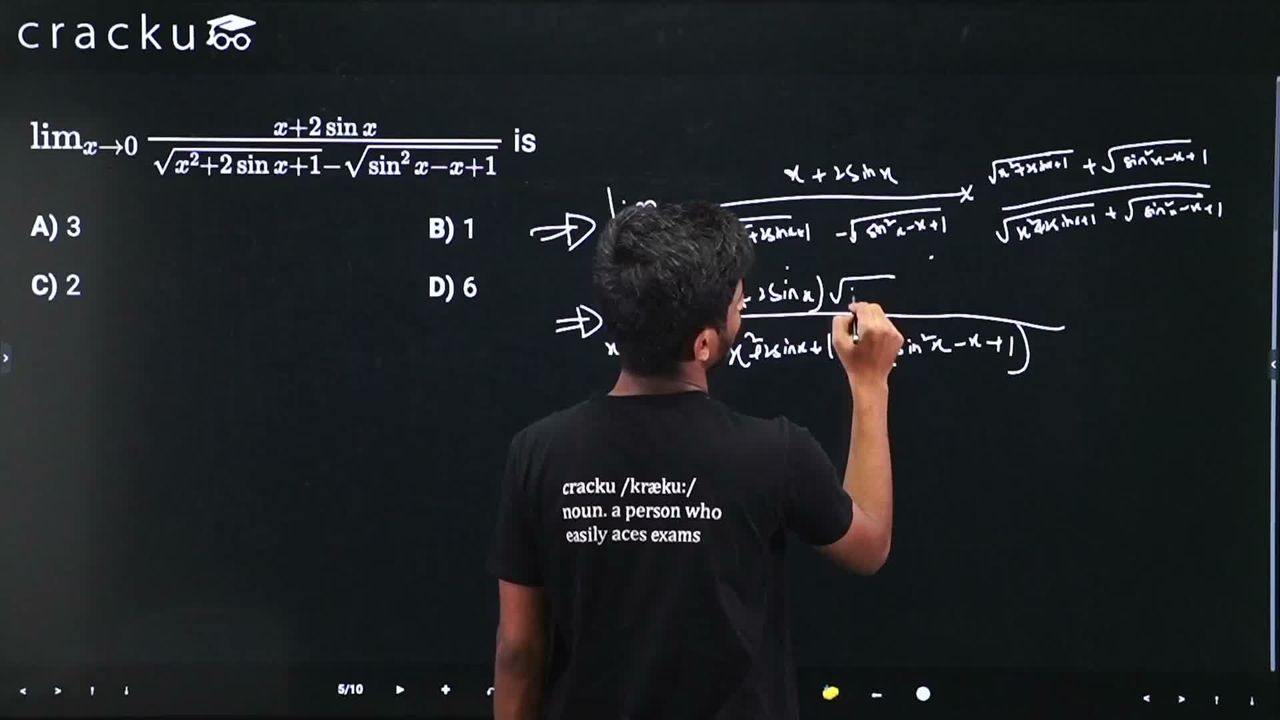
$$\lim_{x \to 0} \frac{x + 2\sin x}{\sqrt{x^2 + 2\sin x + 1} - \sqrt{\sin^2 x - x + 1}}$$ is
We begin with the limit
$$L=\lim_{x\to0}\dfrac{x+2\sin x}{\sqrt{x^{2}+2\sin x+1}-\sqrt{\sin^{2}x-x+1}}.$$
Both the numerator and the denominator approach $$0$$ as $$x\to0$$, so L’Hôpital’s Rule is applicable. L’Hôpital’s Rule states that for functions $$f(x)$$ and $$g(x)$$ which satisfy $$f(0)=g(0)=0$$ and have derivatives continuous near $$0$$, we have
$$\lim_{x\to0}\dfrac{f(x)}{g(x)}=\lim_{x\to0}\dfrac{f'(x)}{g'(x)}$$
provided the limit on the right exists.
We set
$$f(x)=x+2\sin x,\qquad g(x)=\sqrt{x^{2}+2\sin x+1}-\sqrt{\sin^{2}x-x+1}.$$
Derivative of the numerator
$$f'(x)=1+2\cos x.$$
Therefore
$$f'(0)=1+2\cos0=1+2\cdot1=3.$$
Derivative of the denominator
Write $$g(x)=u(x)-v(x)$$ with
$$u(x)=\sqrt{x^{2}+2\sin x+1},\qquad v(x)=\sqrt{\sin^{2}x-x+1}.$$
Using $$\dfrac{d}{dx}\sqrt{h(x)}=\dfrac{h'(x)}{2\sqrt{h(x)}}$$ we find
$$u'(x)=\dfrac{2x+2\cos x}{2\sqrt{x^{2}+2\sin x+1}} =\dfrac{x+\cos x}{\sqrt{x^{2}+2\sin x+1}},$$
$$v'(x)=\dfrac{2\sin x\cos x-1}{2\sqrt{\sin^{2}x-x+1}} =\dfrac{\sin x\cos x-\dfrac12}{\sqrt{\sin^{2}x-x+1}}.$$
Hence
$$g'(x)=u'(x)-v'(x) =\dfrac{x+\cos x}{\sqrt{x^{2}+2\sin x+1}} -\dfrac{\sin x\cos x-\dfrac12}{\sqrt{\sin^{2}x-x+1}}.$$
Now evaluate $$g'(x)$$ at $$x=0$$. We know $$\sin0=0,\;\cos0=1$$, and both radicals become $$\sqrt1=1$$. Substituting,
$$g'(0)=\dfrac{0+1}{1}-\dfrac{0\cdot1-\dfrac12}{1} =1-\Bigl(-\dfrac12\Bigr)=1+\dfrac12=\dfrac32.$$
Applying L’Hôpital’s Rule
$$L=\lim_{x\to0}\dfrac{f(x)}{g(x)} =\lim_{x\to0}\dfrac{f'(x)}{g'(x)} =\dfrac{f'(0)}{g'(0)} =\dfrac{3}{\dfrac32}=2.$$
So, the answer is $$2$$.
Was this solution helpful?
Click on the Email ☝️ to Watch the Video Solution
Create a FREE account and get:
_1.webp)

Educational materials for JEE preparation

Ask our AI anything

AI can make mistakes. Please verify important information.
AI can make mistakes. Please verify important information.


