
Join Our JEE Preparation Group
Prep with like-minded aspirants; Get access to free daily tests and study material.
Sign in
Please select an account to continue using cracku.in
↓ →
Join Our JEE Preparation Group
Prep with like-minded aspirants; Get access to free daily tests and study material.
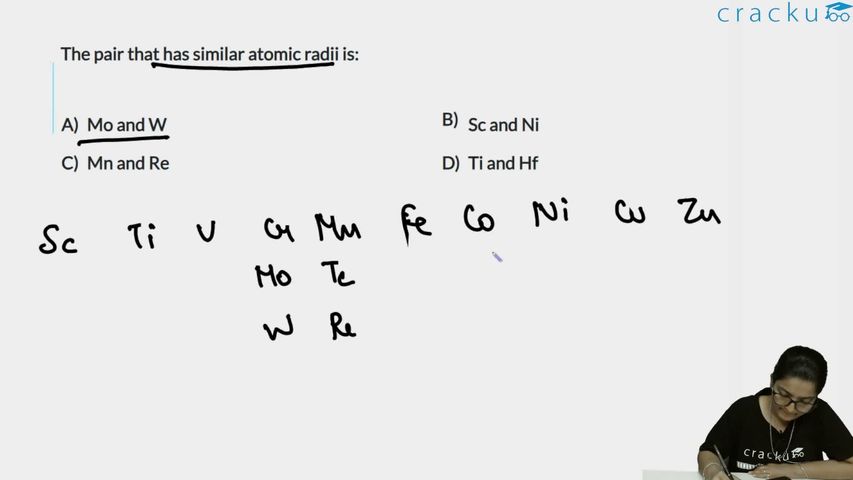
We start with the basic fact that metallic or atomic radius changes in a regular way in the periodic table. Within a given group (vertical column) the radius normally increases from top to bottom because each succeeding element has an extra electron shell.
However, between the 4d-series (elements of the 5th period) and the 5d-series (elements of the 6th period) this normal increase is largely cancelled by the well-known lanthanide contraction.
The lanthanide contraction is the steady decrease in size of the fourteen elements from $$\text{La}$$ to $$\text{Lu}$$ caused by inadequate shielding of the increasing nuclear charge by the 4f-electrons. Because of this poor shielding, the effective nuclear charge $$Z_{\text{eff}}$$ felt by the outer 5d-electrons of the 5d-series becomes almost the same as that felt by the outer 4d-electrons of the 4d-series. Hence the atomic radii of 4d and 5d elements lying in the same group turn out to be nearly equal.
Now we examine each pair given in the options.
Option A Mo and W
$$\text{Mo}$$ (atomic number 42) belongs to the 4d-series and group 6.
$$\text{W}$$ (atomic number 74) belongs to the 5d-series and the same group 6.
Because of the lanthanide contraction, the increase in size that should have occurred from Mo to W is almost exactly cancelled. Experimental metallic radii are
$$r_{\text{Mo}}\;=\;139\;\text{pm}, \qquad r_{\text{W}}\;=\;139\;\text{pm}.$$
The two values are practically identical.
Option B Sc and Ni
Both are 3d-series elements (period 4) but lie at opposite ends of that series (group 3 and group 10). Across a period the radius decreases markedly because effective nuclear charge increases. Thus $$r_{\text{Sc}} > r_{\text{Ni}}$$ by a large margin, so the radii are not similar.
Option C Mn and Re
$$\text{Mn}$$ is a 3d-series element of group 7, whereas $$\text{Re}$$ is a 5d-series element of the same group. The difference here is two whole shells (3d vs 5d), so even after the lanthanide contraction the size of $$\text{Re}$$ (about $$151\;\text{pm}$$) remains appreciably larger than that of $$\text{Mn}$$ (about $$127\;\text{pm}$$). Therefore their radii are not sufficiently close.
Option D Ti and Hf
$$\text{Ti}$$ (3d, group 4) and $$\text{Hf}$$ (5d, group 4) differ by two shells. Their metallic radii are approximately $$147\;\text{pm}$$ and $$159\;\text{pm}$$, respectively. The difference of about $$12\;\text{pm}$$ is significant and larger than that between Mo and W.
Comparing all four cases, the only pair whose atomic radii are virtually the same because they belong to the 4d and 5d series of the same group, and for which numerical values confirm the closeness, is the pair in Option A: Mo and W.
Hence, the correct answer is Option A.
Was this solution helpful?
Click on the Email ☝️ to Watch the Video Solution
Create a FREE account and get:
_1.webp)

Educational materials for JEE preparation

Ask our AI anything

AI can make mistakes. Please verify important information.
AI can make mistakes. Please verify important information.


