Join WhatsApp Icon JEE WhatsApp Group

NTA JEE Main 12th January 2019 Shift 1

For the following questions answer them individually

A person standing on an open ground hears the sound of a jet aeroplane, coming from north at an angle $$60°$$ with ground level, but he finds the aeroplane right vertically above his position. If $$v$$ is the speed of sound, speed of the plane is:

A passenger train of length 60 m travels at a speed of 80 km/hr. Another freight train of length 120 m travels at a speed of 30 km/hr. The ratio of times taken by the passenger train to completely cross the freight train when: (i) they are moving in the same direction, and (ii) in the opposite directions is:

A simple pendulum, made of a string of length $$l$$ and a bob of mass $$m$$, is released from a small angle $$\theta_0$$. It strikes a block of mass $$M$$, kept on horizontal surface at its lowest point of oscillations, elastically. It bounces back and goes up to an angle $$\theta_1$$. Then M is given by:

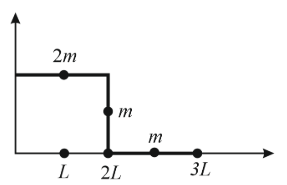
The position vector of the center of mass $$\vec{r_{cm}}$$ of an asymmetric uniform bar of negligible area of cross-section as shown in figure is:

image

Let the moment of inertia of a hollow cylinder of length 30 cm (inner radius 10 cm and outer radius 20 cm), about its axis be I. The radius of a thin cylinder of the same mass such that its moment of inertia about its axis is also I, is:

A satellite of mass M is in a circular orbit of radius R about the center of the earth. A meteorite of the same mass, falling towards the earth, collides with the satellite completely inelastic. The speeds of the satellite and the meteorite are the same, just before the collision. The subsequent motion of the combined body will be:

A straight rod of length L extends from $$x = a$$ to $$x = L + a$$. The gravitational force it exerts on a point mass 'm' at $$x = 0$$, if the mass per unit length of the rod is $$A + Bx^2$$, is given by:

A cylinder of radius R is surrounded by a cylindrical shell of inner radius R and outer radius 2R. The thermal conductivity of the material of the inner cylinder is $$K_1$$ and that of the outer cylinder is $$K_2$$. Assuming no loss of heat, the effective thermal conductivity of the system for heat flowing along the length of the cylinder is:

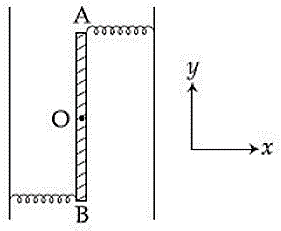
Two light identical springs of spring constant k are attached horizontally at the two ends of a uniform horizontal rod AB of length l and mass m. The rod is pivoted at its center 'O' and can rotate freely in horizontal plane. The other ends of the two springs are fixed to rigid supports as shown in figure. The rod is gently pushed through a small angle and released. The frequency of resulting oscillation is:

A travelling harmonic wave is represented by the equation $$y(x, t) = 10^{-3} \sin(50t + 2x)$$, where x and y are in meter and t is in seconds. Which of the following is a correct statement about the wave?

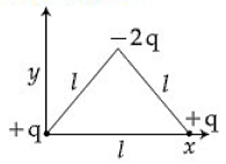
Determine the electric dipole moment of the system of three charges, placed on the vertices of an equilateral triangle, as shown in the figure:

There is a uniform spherically symmetric surface charge density at a distance $$R_0$$ from the origin. The charge distribution is initially at rest and starts expanding because of mutual repulsion. The figure that represents best the speed $$V(R(t))$$ of the distribution as a function of its instantaneous radius $$R(t)$$ is:

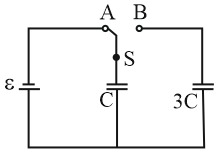
The figure shows a capacitor of capacitance C connected to a battery via a switch, having a total charge Q on it, in steady-state. When the switch S is turned from position A to position B, the energy dissipated in the circuit is

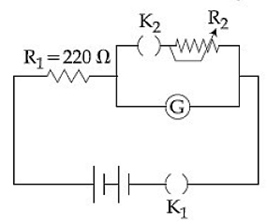
The galvanometer deflection, when key $$K_1$$ is closed but $$K_2$$ is open, equals $$\theta_0$$ (see figure). On closing $$K_2$$ also and adjusting $$R_2$$ to $$5\Omega$$, the deflection in galvanometer becomes $$\frac{\theta_0}{5}$$. The resistance of the galvanometer is, then, given by [Neglect the internal resistance of battery]:

An ideal battery of emf 4V and resistance R are connected in series in the primary circuit of a potentiometer of length 1 m and resistance $$5\Omega$$. The value of R, to give a potential difference of 5 mV across 10 cm of potentiometer wire, is:

Two electric bulbs, rated at (25 W, 220 V) and (100 W, 220 V), are connected in series across a 220 V voltage source. If the 25 W and 100 W bulbs draw powers $$P_1$$ and $$P_2$$ respectively, then:

A proton and an $$\alpha$$-particle (with their masses in the ratio of 1 : 4 and charges in the ratio of 1 : 2) are accelerated from rest through a potential difference V. If a uniform magnetic field (B) is set up perpendicular to their velocities, the ratio of the radii $$r_p : r_{\alpha}$$ of the circular paths described by them will be:

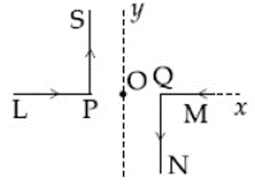
As shown in the figure, two infinitely long, identical wires are bent by 90° and placed in such a way that the segments LP and QM are along the x-axis, while segments PS and QN are parallel to the y-axis. If $$OP = OQ = 4$$ cm, and the magnitude of the magnetic field at O is $$10^{-4}$$ T, and the two wires carry equal currents (see figure), the magnitude of the current in each wire and the direction of the magnetic field at O will be $$\left(\mu_0 = 4\pi \times 10^{-7} NA^{-2}\right)$$:

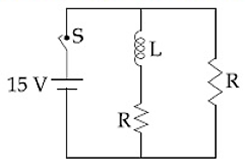
In the figure shown, a circuit contains two identical resistors with resistance $$R = 5\Omega$$ and an inductance with $$L = 2$$ mH. An ideal battery of 15V is connected in the circuit. What will be the current through the battery long after the switch is closed?

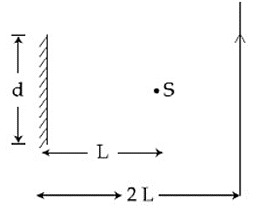
A point source of light, S is placed at a distance L in front of the center of plane mirror of width d which is hanging vertically on a wall. A man walks in front of the mirror along a line parallel to the mirror, at a distance 2L as shown below. The distance over which the man can see the image of the light source in the mirror is:

A light wave is incident normally on a glass slab of refractive index 1.5. If 4% of light gets reflected and the amplitude of the electric field of the incident light is 30 V/m, then the amplitude of the electric field for the wave propagating in the glass medium will be:

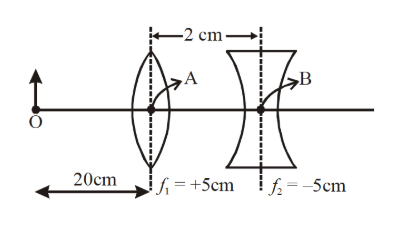
What is the position and nature of image formed by lens combination shown in figure? ($$f_1$$, $$f_2$$ are focal lengths)

A particle A of mass m and charge q is accelerated by a potential difference of 50 V. Another particle B of mass 4m and charge q is accelerated by a potential difference of 2500 V. The ratio of de-Broglie wavelengths $$\frac{\lambda_A}{\lambda_B}$$ is close to:

A particle of mass m moves in a circular orbit in a central potential field $$U(r) = \frac{1}{2}kr^2$$. If Bohr's quantization conditions are applied, radii of possible orbitals and energy levels vary with quantum number n as:

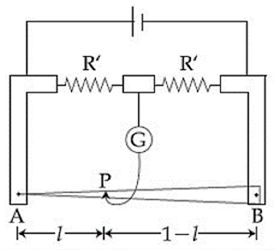
In a meter bridge, the wire of length 1 m has a non-uniform cross-section such that, the variation $$\frac{dR}{dl}$$ of its resistance R with length l is $$\frac{dR}{dl} \propto \frac{1}{\sqrt{l}}$$. Two equal resistances are connected as shown in the figure. The galvanometer has zero deflection when the jockey is at point P. What is the length AP?

What is the work function of the metal if the light of wavelength 4000 $$\mathring{A}$$ generates photoelectrons of velocity $$6 \times 10^5$$ ms$$^{-1}$$ from it? (Mass of electron $$= 9 \times 10^{-31}$$ kg, velocity of light $$= 3 \times 10^8$$ ms$$^{-1}$$, Planck's constant $$= 6.626 \times 10^{-34}$$ Js, Charge of electron $$= 6.626 \times 10^{-34}$$ Js)

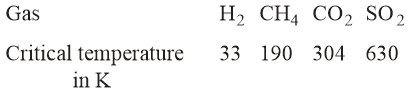
The volume of gas A is twice than that of gas B. The compressibility factor of gas A is thrice than that of gas B at same temperature. What are the pressures of the gases for equal number of moles?

In a chemical reaction, $$A + 2B \xrightleftharpoons{K} 2C + D$$, the initial concentration of B was 1.5 times the concentration of A, but the equilibrium concentrations of A and B were found to be equal. The equilibrium constant (K) for the chemical reaction is:

Two solids dissociate as follows: $$A(s) \rightleftharpoons B(g) + C(g)$$; $$K_{P_1} = x$$ atm$$^2$$, $$D(s) \rightleftharpoons C(g) + E(g)$$; $$K_{P_2} = y$$ atm$$^2$$. The total pressure when both the solids dissociate simultaneously is:

What is the hardness of a water sample (in terms of equivalents of CaCO$$_3$$) containing $$10^{-3}$$ M CaSO$$_4$$? (Molar mass of CaSO$$_4$$ = 136 g mol$$^{-1}$$)

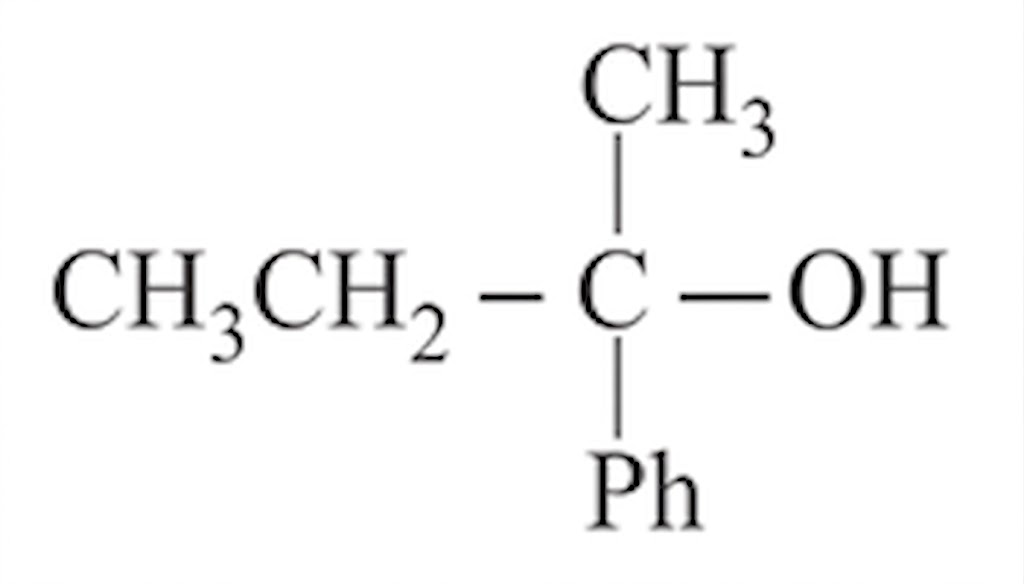
The correct order for acid strength of compounds $$CH \equiv CH$$, $$CH_3 - C \equiv CH$$ and $$CH_2 = CH_2$$ is as follows:

The standard electrode potential E° and its temperature coefficient $$\left(\frac{dE}{dT}\right)$$ for a cell are 2 V and $$-5 \times 10^{-4}$$ V K$$^{-1}$$ at 300 K, respectively. The reaction is Zn(s) + Cu$$^{2+}$$(aq) $$\to$$ Zn$$^{2+}$$(aq) + Cu(s). The standard reaction enthalpy $$(\Delta_r H^-)$$ at 300 K in mol$$^{-1}$$ is [Use R = 8 J K$$^{-1}$$ mol$$^{-1}$$ and F = 96,500 C mol$$^{-1}$$]

The pair of metal ions that can give a spin only magnetic moment of 3.9 BM for the complex $$[M(H_2O)_6]Cl_2$$, is:

The metal's d-orbitals that are directly facing the ligands in $$K_3[Co(CN)_6]$$ are:

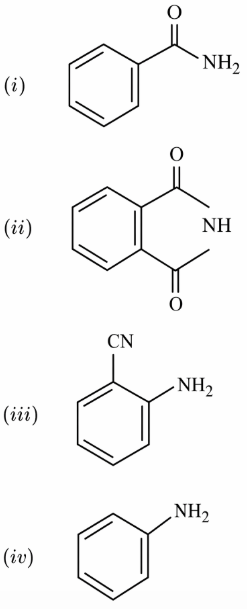
The increasing order of reactivity of the following compounds towards reaction with alkyl halides directly is:

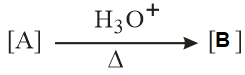
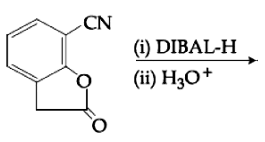
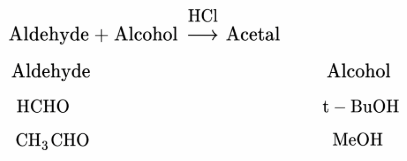
image

Poly-$$\beta$$-hydroxybutyrate-co-$$\beta$$-hydroxyvalerate (PHBV) is a copolymer of ____.

If $$\lambda$$ be the ratio of the roots of the quadratic equation in x, $$3m^2x^2 + m(m-4)x + 2 = 0$$, then the least value of m for which $$\lambda + \frac{1}{\lambda} = 1$$, is:

Consider three boxes, each containing 10 balls labelled 1, 2, ..., 10. Suppose one ball is randomly drawn from each of the boxes. Denote by $$n_i$$, the label of the ball drawn from the $$i^{th}$$ box, $$(i = 1, 2, 3)$$. Then, the number of ways in which the balls can be chosen such that $$n_1 < n_2 < n_3$$ is:

If the straight line $$2x - 3y + 17 = 0$$ is perpendicular to the line passing through the points $$(7, 17)$$ and $$(15, \beta)$$, then $$\beta$$ equals:

Let $$C_1$$ and $$C_2$$ be the centres of the circles $$x^2 + y^2 - 2x - 2y - 2 = 0$$ and $$x^2 + y^2 - 6x - 6y + 14 = 0$$ respectively. If P and Q are the points of intersection of these circles, then the area (in sq. units) of the quadrilateral $$PC_1QC_2$$ is:

If a variable line $$3x + 4y - \lambda = 0$$ is such that the two circles $$x^2 + y^2 - 2x - 2y + 1 = 0$$ and $$x^2 + y^2 - 18x - 2y + 78 = 0$$ are on its opposite sides, then the set of all values of $$\lambda$$ is the interval:

Let $$P(4, -4)$$ and $$Q(9, 6)$$ be two points on the parabola, $$y^2 = 4x$$ and let X be any point on the arc POQ of this parabola, where O is the vertex of this parabola, such that the area of $$\Delta PXQ$$ is maximum. Then this maximum area (in sq. units) is:

If the vertices of a hyperbola be at $$(-2, 0)$$ and $$(2, 0)$$ and one of its foci be at $$(-3, 0)$$, then which one of the following points does not lie on this hyperbola?

The Boolean expression $$((p \wedge q) \vee (p \vee \sim q)) \wedge (\sim p \wedge \sim q)$$ is equivalent to

Let $$P = \begin{bmatrix} 1 & 0 & 0 \\ 3 & 1 & 0 \\ 9 & 3 & 1 \end{bmatrix}$$ and $$Q = [q_{ij}]$$ be two $$3 \times 3$$ matrices such that $$Q - P^5 = I_3$$. Then $$\frac{q_{21} + q_{31}}{q_{32}}$$ is equal to:

Let S be the set of all points in $$(-\pi, \pi)$$ at which the function, $$f(x) = \min\{\sin x, \cos x\}$$ is not differentiable. Then S is a subset of which of the following?

For $$x \gt 1$$, if $$(2x)^{2y} = 4e^{2x-2y}$$, then $$(1 + \log_e 2x)^2 \frac{dy}{dx}$$ is equal to

The maximum area (in sq. units) of a rectangle having its base on the x-axis and its other two vertices on the parabola, $$y = 12 - x^2$$ such that the rectangle lies inside the parabola, is:

The integral $$\int \cos(\ln x) dx$$, is equal to

Let $$y = y(x)$$ be the solution of the differential equation, $$x\frac{dy}{dx} + y = x\log_e x$$, $$(x > 1)$$. If $$2y(2) = \log_e 4 - 1$$, then $$y(e)$$ is equal to

A tetrahedron has vertices P(1, 2, 1), Q(2, 1, 3), R(-1, 1, 2) and O(0, 0, 0). The angle between the faces OPQ and PQR is

The perpendicular distance from the origin to the plane containing the two lines, $$\frac{x+2}{3} = \frac{y-2}{5} = \frac{z+5}{7}$$ and $$\frac{x-1}{1} = \frac{y-4}{4} = \frac{z+4}{7}$$, is

In a random experiment, a fair die is rolled until two fours are obtained in succession. The probability that the experiment will end in the fifth throw of the die is equal to: