
Join Our JEE Preparation Group
Prep with like-minded aspirants; Get access to free daily tests and study material.
Sign in
Please select an account to continue using cracku.in
↓ →
Join Our JEE Preparation Group
Prep with like-minded aspirants; Get access to free daily tests and study material.
$$\lim_{x \to \frac{\pi}{4}} \frac{\cot^3 x - \tan x}{\cos\left(x + \frac{\pi}{4}\right)}$$ is
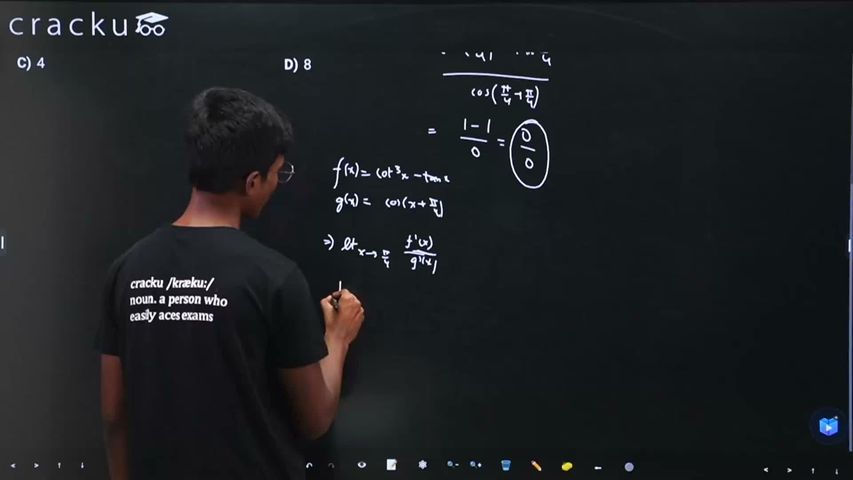
We have to evaluate the limit
$$\displaystyle L=\lim_{x\to\frac{\pi}{4}} \frac{\cot^{3}x-\tan x}{\cos\!\left(x+\dfrac{\pi}{4}\right)}.$$
First we note the values of the functions at the point of approach. When $$x=\dfrac{\pi}{4}$$ we get $$\tan\dfrac{\pi}{4}=1,\qquad \cot\dfrac{\pi}{4}=1,$$ hence
$$\cot^{3}\dfrac{\pi}{4}-\tan\dfrac{\pi}{4}=1^{3}-1=0.$$
Also
$$\cos\!\left(\dfrac{\pi}{4}+\dfrac{\pi}{4}\right) =\cos\dfrac{\pi}{2}=0.$$
Because both the numerator and the denominator approach $$0,$$ the limit is of the indeterminate form $$\dfrac{0}{0}.$$ Therefore we can apply L’Hôpital’s Rule, which says:
$$\text{If } \displaystyle\lim_{x\to a}\frac{f(x)}{g(x)}= \frac{0}{0}\text{ or }\frac{\infty}{\infty}, \text{ then } \displaystyle\lim_{x\to a}\frac{f(x)}{g(x)}= \displaystyle\lim_{x\to a}\frac{f'(x)}{g'(x)},$$ provided the latter limit exists.
So we differentiate the numerator and the denominator with respect to $$x.$$
For the numerator $$f(x)=\cot^{3}x-\tan x$$ we write
$$f'(x)=\frac{d}{dx}\bigl(\cot^{3}x\bigr)-\frac{d}{dx}\bigl(\tan x\bigr).$$
We recall the derivatives $$\frac{d}{dx}(\cot x)=-\csc^{2}x \quad\text{and}\quad \frac{d}{dx}(\tan x)=\sec^{2}x.$$
Using the chain rule on the first term we get
$$\frac{d}{dx}\bigl(\cot^{3}x\bigr)=3\cot^{2}x\cdot(\!-\csc^{2}x) =-3\cot^{2}x\,\csc^{2}x.$$
Thus
$$f'(x)=-3\cot^{2}x\,\csc^{2}x-\sec^{2}x.$$
For the denominator $$g(x)=\cos\!\left(x+\dfrac{\pi}{4}\right)$$ we use the derivative $$\dfrac{d}{dx}\cos u=-\sin u\cdot\dfrac{du}{dx}.$$ Here $$u=x+\dfrac{\pi}{4},$$ so $$\dfrac{du}{dx}=1,$$ and consequently
$$g'(x)=-\sin\!\left(x+\dfrac{\pi}{4}\right).$$
Now we evaluate the derivatives at $$x=\dfrac{\pi}{4}.$$
First compute the trigonometric values:
$$\cot\dfrac{\pi}{4}=1,\; \csc\dfrac{\pi}{4}=\frac{1}{\sin\dfrac{\pi}{4}} =\frac{1}{\dfrac{\sqrt2}{2}}=\sqrt2,\; \sec\dfrac{\pi}{4}=\frac{1}{\cos\dfrac{\pi}{4}} =\frac{1}{\dfrac{\sqrt2}{2}}=\sqrt2.$$
Hence
$$\cot^{2}\dfrac{\pi}{4}=1,\qquad \csc^{2}\dfrac{\pi}{4}=2,\qquad \sec^{2}\dfrac{\pi}{4}=2.$$
Substituting in $$f'(x)$$ gives
$$f'\!\left(\dfrac{\pi}{4}\right) =-3(1)(2)-2=-6-2=-8.$$
For the denominator we find
$$g'\!\left(\dfrac{\pi}{4}\right) =-\sin\!\left(\dfrac{\pi}{4}+\dfrac{\pi}{4}\right) =-\sin\dfrac{\pi}{2}=-1.$$
Applying L’Hôpital’s Rule we have
$$L=\lim_{x\to\frac{\pi}{4}}\frac{f(x)}{g(x)} =\lim_{x\to\frac{\pi}{4}}\frac{f'(x)}{g'(x)} =\frac{f'\!\left(\dfrac{\pi}{4}\right)} {g'\!\left(\dfrac{\pi}{4}\right)} =\frac{-8}{-1}=8.$$
Hence, the correct answer is Option D.
Was this solution helpful?
Click on the Email ☝️ to Watch the Video Solution
Create a FREE account and get:
Educational materials for JEE preparation

Ask our AI anything

AI can make mistakes. Please verify important information.
AI can make mistakes. Please verify important information.

_1.webp)
