
Join Our JEE Preparation Group
Prep with like-minded aspirants; Get access to free daily tests and study material.
Sign in
Please select an account to continue using cracku.in
↓ →
Join Our JEE Preparation Group
Prep with like-minded aspirants; Get access to free daily tests and study material.
The figure shows a capacitor of capacitance C connected to a battery via a switch, having a total charge Q on it, in steady-state. When the switch S is turned from position A to position B, the energy dissipated in the circuit is
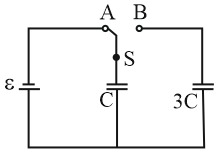
$$\text{Initially, switch S is at position A. The capacitor } C \text{ is fully charged to charge } Q:$$
$$\text{Initial stored electrostatic energy: } U_i = \frac{Q^2}{2C}$$
When the switch S is shifted to position B, the charged capacitor C is connected in parallel with an uncharged capacitor 3C
$$\text{Total equivalent capacitance in parallel: } C_{\text{eq}} = C + 3C = 4C$$
$$\text{By conservation of charge, the total charge remains } Q.$$
$$\text{Final stored electrostatic energy: } U_f = \frac{Q^2}{2C_{\text{eq}}} = \frac{Q^2}{2(4C)} = \frac{Q^2}{8C}$$
$$\text{Energy dissipated as heat in the circuit: } \Delta H = U_i - U_f$$
$$\Delta H = \frac{Q^2}{2C} - \frac{Q^2}{8C} = \left(\frac{4 - 1}{8}\right)\frac{Q^2}{C} = \frac{3}{8}\frac{Q^2}{C}$$
Was this solution helpful?
Create a FREE account and get:
_1.webp)

Educational materials for JEE preparation

Ask our AI anything

AI can make mistakes. Please verify important information.
AI can make mistakes. Please verify important information.
