
Join Our JEE Preparation Group
Prep with like-minded aspirants; Get access to free daily tests and study material.
Sign in
Please select an account to continue using cracku.in
↓ →
Join Our JEE Preparation Group
Prep with like-minded aspirants; Get access to free daily tests and study material.
The galvanometer deflection, when key $$K_1$$ is closed but $$K_2$$ is open, equals $$\theta_0$$ (see figure). On closing $$K_2$$ also and adjusting $$R_2$$ to $$5\Omega$$, the deflection in galvanometer becomes $$\frac{\theta_0}{5}$$. The resistance of the galvanometer is, then, given by [Neglect the internal resistance of battery]:
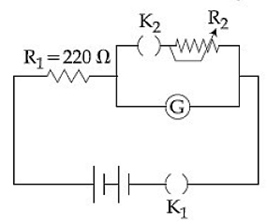
Deflection is directly proportional to current: $$I_g \propto \theta$$
Case 1 ($$K_1$$ closed, $$K_2$$ open): $$I_{g1} = \frac{V}{R_1 + G} = C\theta_0$$
Case 2 ($$K_1$$ closed, $$K_2$$ closed): $$R_{\text{eq}} = R_1 + \frac{G R_2}{G + R_2}$$
$$I_{\text{total}} = \frac{V}{R_1 + \frac{G R_2}{G + R_2}} = \frac{V(G + R_2)}{R_1(G + R_2) + G R_2}$$
Current dividing into galvanometer branch:
$$I_{g2} = I_{\text{total}} \times \frac{R_2}{G + R_2} = \frac{V R_2}{R_1(G + R_2) + G R_2} = C\frac{\theta_0}{5}$$
Dividing Case 1 by Case 2:
$$\frac{I_{g1}}{I_{g2}} = \frac{\frac{V}{R_1 + G}}{\frac{V R_2}{R_1 G + R_1 R_2 + G R_2}} = 5$$
$$\frac{R_1 G + R_1 R_2 + G R_2}{R_2(R_1 + G)} = 5 \implies \frac{R_1 G}{R_2(R_1 + G)} + 1 = 5$$
$$\frac{R_1 G}{R_2(R_1 + G)} = 4$$
$$\frac{220 \cdot G}{5(220 + G)} = 4 \implies 44G = 4(220 + G)$$
$$11G = 220 + G \implies 10G = 220 \implies G = 22\ \Omega$$
Was this solution helpful?
Create a FREE account and get:
_1.webp)

Educational materials for JEE preparation

Ask our AI anything

AI can make mistakes. Please verify important information.
AI can make mistakes. Please verify important information.
