
Join Our JEE Preparation Group
Prep with like-minded aspirants; Get access to free daily tests and study material.
Sign in
Please select an account to continue using cracku.in
↓ →
Join Our JEE Preparation Group
Prep with like-minded aspirants; Get access to free daily tests and study material.
A tetrahedron has vertices P(1, 2, 1), Q(2, 1, 3), R(-1, 1, 2) and O(0, 0, 0). The angle between the faces OPQ and PQR is
We have a tetrahedron whose four vertices are $$P(1,2,1)$$, $$Q(2,1,3)$$, $$R(-1,1,2)$$ and $$O(0,0,0)$$.
The required angle is the angle between the two faces $$OPQ$$ and $$PQR.$$ An angle between two planes is equal to the angle between their normals. So, we shall first find a normal vector to each face and then use the dot-product formula to obtain the angle.
Normal to face $$OPQ$$
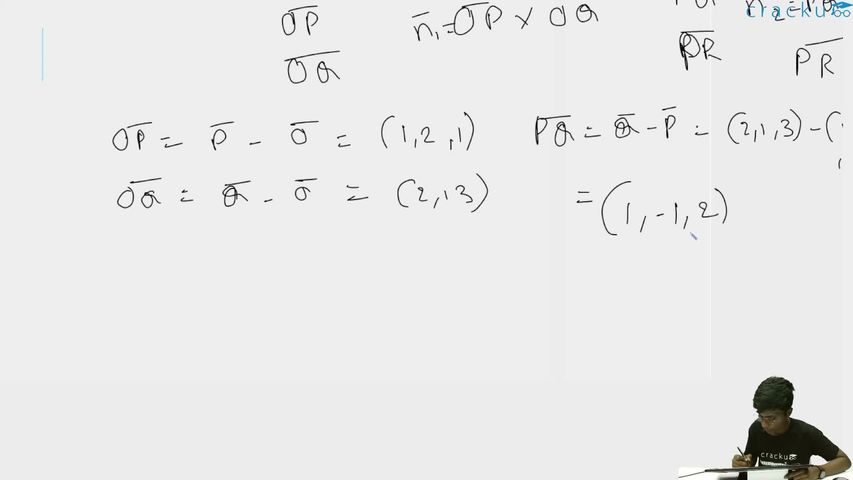
For the plane through $$O, P, Q$$ we can take the two direction vectors
$$\overrightarrow{OP}=P-O=(1,\,2,\,1),\qquad \overrightarrow{OQ}=Q-O=(2,\,1,\,3).$$
We know that the cross-product of two non-parallel vectors lying in a plane gives a vector perpendicular to that plane. Hence, using the formula
$$\overrightarrow{a}\times\overrightarrow{b}=(a_2b_3-a_3b_2,\,a_3b_1-a_1b_3,\,a_1b_2-a_2b_1),$$
we compute
$$\overrightarrow{n_1}=\overrightarrow{OP}\times\overrightarrow{OQ}$$
$$=\begin{vmatrix} \mathbf{i}&\mathbf{j}&\mathbf{k}\\ 1&2&1\\ 2&1&3 \end{vmatrix} =(2\cdot3-1\cdot1)\,\mathbf{i}-(1\cdot3-1\cdot2)\,\mathbf{j}+(1\cdot1-2\cdot2)\,\mathbf{k}$$
$$=(6-1,\,-(3-2),\,(1-4))=(5,\,-1,\,-3).$$
Thus $$\overrightarrow{n_1}=(5,\,-1,\,-3).$$
Normal to face $$PQR$$
The plane through $$P, Q, R$$ contains the direction vectors
$$\overrightarrow{PQ}=Q-P=(2-1,\,1-2,\,3-1)=(1,\,-1,\,2),$$
$$\overrightarrow{PR}=R-P=(-1-1,\,1-2,\,2-1)=(-2,\,-1,\,1).$$
Again applying the cross-product formula, we get
$$\overrightarrow{n_2}=\overrightarrow{PQ}\times\overrightarrow{PR}$$
Here $$\overrightarrow{PQ}=(a_1,a_2,a_3)=(1,\,-1,\,2)$$ and $$\overrightarrow{PR}=(b_1,b_2,b_3)=(-2,\,-1,\,1).$$
Therefore
$$\overrightarrow{n_2}=(a_2b_3-a_3b_2,\;a_3b_1-a_1b_3,\;a_1b_2-a_2b_1)$$
$$=(-1\cdot1-2\cdot(-1),\;2\cdot(-2)-1\cdot1,\;1\cdot(-1)-(-1)\cdot(-2))$$
$$=( -1+2,\;-4-1,\;-1-2 )=(1,\,-5,\,-3).$$
Hence $$\overrightarrow{n_2}=(1,\,-5,\,-3).$$
Angle between the faces
Let $$\theta$$ be the angle between the two planes. Using the dot-product formula for vectors,
$$\overrightarrow{n_1}\cdot\overrightarrow{n_2}=|\overrightarrow{n_1}|\,|\overrightarrow{n_2}|\,\cos\theta.$$
First, we calculate the dot product:
$$\overrightarrow{n_1}\cdot\overrightarrow{n_2}=5\cdot1+(-1)\cdot(-5)+(-3)\cdot(-3)=5+5+9=19.$$
Next, we need the magnitudes of the normals:
$$|\overrightarrow{n_1}|=\sqrt{5^2+(-1)^2+(-3)^2}=\sqrt{25+1+9}=\sqrt{35},$$
$$|\overrightarrow{n_2}|=\sqrt{1^2+(-5)^2+(-3)^2}=\sqrt{1+25+9}=\sqrt{35}.$$
Substituting these values into the dot-product equation, we obtain
$$19=\sqrt{35}\,\sqrt{35}\,\cos\theta\; \Longrightarrow\;19=35\cos\theta.$$
So,
$$\cos\theta=\frac{19}{35}.$$
Taking the principal inverse cosine gives
$$\theta=\cos^{-1}\!\left(\frac{19}{35}\right).$$
Looking at the given options, this matches Option C.
Hence, the correct answer is Option C.
Was this solution helpful?
Click on the Email ☝️ to Watch the Video Solution
Create a FREE account and get:
_1.webp)

Educational materials for JEE preparation

Ask our AI anything

AI can make mistakes. Please verify important information.
AI can make mistakes. Please verify important information.
