
Join Our JEE Preparation Group
Prep with like-minded aspirants; Get access to free daily tests and study material.
Sign in
Please select an account to continue using cracku.in
↓ →
Join Our JEE Preparation Group
Prep with like-minded aspirants; Get access to free daily tests and study material.
The perpendicular distance from the origin to the plane containing the two lines, $$\frac{x+2}{3} = \frac{y-2}{5} = \frac{z+5}{7}$$ and $$\frac{x-1}{1} = \frac{y-4}{4} = \frac{z+4}{7}$$, is
We first recognise that the required plane passes through each of the two given lines, so any one convenient point from each line and the two direction vectors of the lines will completely determine that plane.
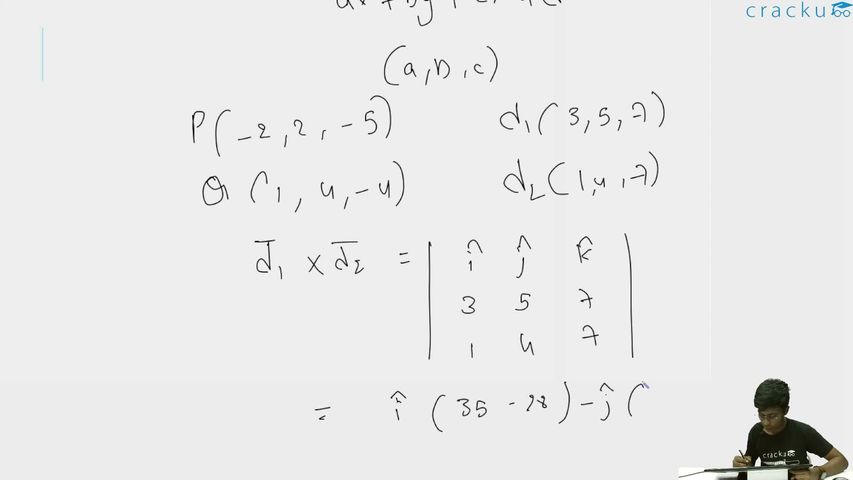
For the first line $$\dfrac{x+2}{3}=\dfrac{y-2}{5}=\dfrac{z+5}{7}$$ we introduce a parameter, say $$r$$, such that
$$x+2=3r,\;y-2=5r,\;z+5=7r.$$
Thus one point on this line is obtained by putting $$r=0$$:
$$P(-2,\,2,\,-5).$$
The direction ratios of the first line are clearly $$3,5,7,$$ so the direction vector of the first line is $$\mathbf a=\langle3,5,7\rangle.$$
For the second line $$\dfrac{x-1}{1}=\dfrac{y-4}{4}=\dfrac{z+4}{7}$$ we set the common value to be $$s$$ and write
$$x-1=s,\;y-4=4s,\;z+4=7s.$$
On taking $$s=0$$ we get the point
$$Q(1,\,4,\,-4).$$
The direction ratios of this line are $$1,4,7,$$ hence its direction vector is $$\mathbf b=\langle1,4,7\rangle.$$
The normal vector to the plane is obtained by the cross-product of the two direction vectors. Using
$$\mathbf n=\mathbf a\times\mathbf b,$$
we compute
$$ \mathbf n= \begin{vmatrix} \mathbf i & \mathbf j & \mathbf k\\ 3 & 5 & 7\\ 1 & 4 & 7 \end{vmatrix} =\mathbf i(5\cdot7-7\cdot4)-\mathbf j(3\cdot7-7\cdot1)+\mathbf k(3\cdot4-5\cdot1) =7\mathbf i-14\mathbf j+7\mathbf k. $$
Thus $$\mathbf n=\langle7,-14,7\rangle=7\langle1,-2,1\rangle,$$ and for convenience we take the shortened normal vector $$\langle1,-2,1\rangle.$$
With normal vector $$\langle1,-2,1\rangle$$ and a known point on the plane, say $$P(-2,2,-5),$$ the scalar equation of the plane is formed from $$(\mathbf n)\cdot(\mathbf r-\mathbf r_0)=0,$$ i.e.
$$1(x+2)+(-2)(y-2)+1(z+5)=0.$$
Expanding and collecting like terms gives
$$x+2-2y+4+z+5=0,$$
$$x-2y+z+11=0.$$
To find the perpendicular distance of the origin $$(0,0,0)$$ from this plane, we recall the formula
$$\text{Distance}=\dfrac{|Ax_0+By_0+Cz_0+D|}{\sqrt{A^2+B^2+C^2}},$$
where $$Ax+By+Cz+D=0$$ is the plane and $$(x_0,y_0,z_0)$$ is the point. Here
$$A=1,\;B=-2,\;C=1,\;D=11,\qquad x_0=y_0=z_0=0.$$
Substituting, we get
$$\text{Distance}= \dfrac{|1\cdot0+(-2)\cdot0+1\cdot0+11|}{\sqrt{1^2+(-2)^2+1^2}} =\dfrac{|11|}{\sqrt{1+4+1}} =\dfrac{11}{\sqrt6}.$$
Hence, the correct answer is Option B.
Was this solution helpful?
Click on the Email ☝️ to Watch the Video Solution
Create a FREE account and get:
_1.webp)

Educational materials for JEE preparation

Ask our AI anything

AI can make mistakes. Please verify important information.
AI can make mistakes. Please verify important information.
