
Join Our JEE Preparation Group
Prep with like-minded aspirants; Get access to free daily tests and study material.
Sign in
Please select an account to continue using cracku.in
↓ →
Join Our JEE Preparation Group
Prep with like-minded aspirants; Get access to free daily tests and study material.
In a random experiment, a fair die is rolled until two fours are obtained in succession. The probability that the experiment will end in the fifth throw of the die is equal to:
First recall the definition of “the experiment ends on the fifth throw.” It means that
$$\text{4th throw}=4,\qquad \text{5th throw}=4$$
and that no pair of consecutive throws equal to $$4,4$$ has appeared before this pair. In other words, the pair made by the 4th and 5th throws must be the first occurrence of two successive fours.
Denote the five outcomes by $$x_1,x_2,x_3,x_4,x_5.$$ We have the two fixed conditions
$$x_4=4,\qquad x_5=4.$$
To prevent an earlier “double four,” the following extra conditions are necessary:
1. The pair $$(x_1,x_2)$$ must not be $$(4,4).$$ 2. Because $$x_4=4$$, the pair $$(x_3,x_4)$$ would be $$(4,4)$$ if $$x_3=4$$. Therefore we must force
$$x_3\ne 4.$$
No other restriction is needed, because once $$x_3\ne4$$ the pair $$(x_2,x_3)$$ automatically cannot be $$(4,4).$$
We now count the number of possible ordered triples $$(x_1,x_2,x_3)$$ satisfying these two conditions.
A. Start with the unrestricted count: each $$x_i$$ (for $$i=1,2$$) can be any of the six faces, while $$x_3$$ can be any face except 4. Hence
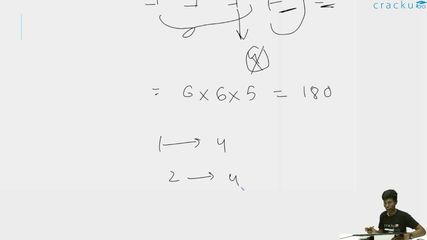
$$6 \times 6 \times 5 = 180$$
total triples before exclusion.
B. Next exclude the forbidden triples where $$(x_1,x_2)=(4,4).$$ If $$x_1=4$$ and $$x_2=4$$, then $$x_3$$ still has the same five possibilities (1,2,3,5,6). Thus the number of disallowed triples is
$$1 \times 1 \times 5 = 5.$$
C. Subtracting, the number of valid triples is
$$180-5=175.$$
For every one of these 175 admissible triples, the fourth and fifth throws are already fixed as $$4,4$$, giving exactly one full sequence of five throws. Therefore the total number of favourable five-throw sequences equals
$$175.$$
Because the die is fair, all $$6^5$$ sequences of five throws are equally likely, and the desired probability is
$$\dfrac{175}{6^5}.$$
Hence, the correct answer is Option B.
Was this solution helpful?
Click on the Email ☝️ to Watch the Video Solution
Create a FREE account and get:
_1.webp)

Educational materials for JEE preparation

Ask our AI anything

AI can make mistakes. Please verify important information.
AI can make mistakes. Please verify important information.
