
Join Our JEE Preparation Group
Prep with like-minded aspirants; Get access to free daily tests and study material.
Sign in
Please select an account to continue using cracku.in
↓ →
Join Our JEE Preparation Group
Prep with like-minded aspirants; Get access to free daily tests and study material.
In a meter bridge, the wire of length 1 m has a non-uniform cross-section such that, the variation $$\frac{dR}{dl}$$ of its resistance R with length l is $$\frac{dR}{dl} \propto \frac{1}{\sqrt{l}}$$. Two equal resistances are connected as shown in the figure. The galvanometer has zero deflection when the jockey is at point P. What is the length AP?
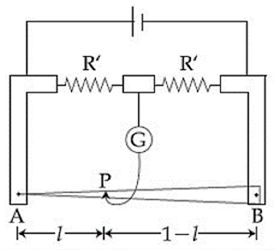
$$\frac{dR}{dl} = \frac{C}{\sqrt{l}}$$
Resistance of segment $$AP$$ of length $$l$$: $$R_{AP} = \int_{0}^{l} \frac{C}{\sqrt{l}} \, dl = 2C\sqrt{l}$$
Resistance of segment $$PB$$ of length $$1-l$$: $$R_{PB} = \int_{l}^{1} \frac{C}{\sqrt{l}} \, dl = [2C\sqrt{l}]_{l}^{1} = 2C(1 - \sqrt{l})$$
Wheatstone bridge balance condition for zero deflection:
$$\frac{R'}{R'} = \frac{R_{AP}}{R_{PB}} \implies 1 = \frac{2C\sqrt{l}}{2C(1 - \sqrt{l})}$$
$$1 - \sqrt{l} = \sqrt{l} \implies 2\sqrt{l} = 1 \implies \sqrt{l} = \frac{1}{2}$$
$$l = \frac{1}{4} = 0.25\text{ m}$$
Was this solution helpful?
Create a FREE account and get:
_1.webp)

Educational materials for JEE preparation

Ask our AI anything

AI can make mistakes. Please verify important information.
AI can make mistakes. Please verify important information.
