
Join Our JEE Preparation Group
Prep with like-minded aspirants; Get access to free daily tests and study material.
Sign in
Please select an account to continue using cracku.in
↓ →
Join Our JEE Preparation Group
Prep with like-minded aspirants; Get access to free daily tests and study material.
What is the work function of the metal if the light of wavelength 4000 $$\mathring{A}$$ generates photoelectrons of velocity $$6 \times 10^5$$ ms$$^{-1}$$ from it? (Mass of electron $$= 9 \times 10^{-31}$$ kg, velocity of light $$= 3 \times 10^8$$ ms$$^{-1}$$, Planck's constant $$= 6.626 \times 10^{-34}$$ Js,$$1\ \text{eV} = 1.602 \times 10^{-19}\ \text{J}$$)
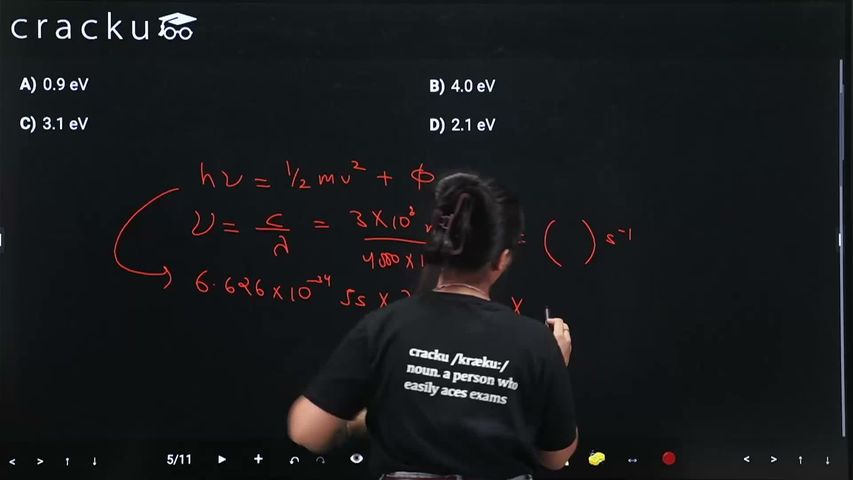
First, recall Einstein’s photo-electric equation, which links the energy of the incident photon to the kinetic energy of the emitted electron and the work function $$\phi$$ of the metal:
$$h\nu = \dfrac{1}{2} m v^{2} + \phi$$
Here $$h$$ is Planck’s constant, $$\nu$$ is the frequency of the light, $$m$$ is the mass of the electron, and $$v$$ is the speed with which the photo-electron emerges.
Because the wavelength $$\lambda$$ of the light is given, we first change it to frequency using the relation $$\nu = \dfrac{c}{\lambda}$$. Stating the values supplied in the question, we have
$$h = 6.626 \times 10^{-34}\ \text{J s}, \quad c = 3.0 \times 10^{8}\ \text{m s}^{-1}, \quad \lambda = 4000\ \text{\AA} = 4000 \times 10^{-10}\ \text{m} = 4.0 \times 10^{-7}\ \text{m}. $$
So the frequency is
$$ \nu = \dfrac{c}{\lambda} = \dfrac{3.0 \times 10^{8}}{4.0 \times 10^{-7}} = 0.75 \times 10^{15}\ \text{s}^{-1} = 7.5 \times 10^{14}\ \text{s}^{-1}. $$
The photon energy $$h\nu$$ is therefore
$$ h\nu = (6.626 \times 10^{-34})(7.5 \times 10^{14}) = 4.9695 \times 10^{-19}\ \text{J}. $$
Next we calculate the kinetic energy of the photo-electron. The electron’s mass is given as $$m = 9.0 \times 10^{-31}\ \text{kg}$$ and its speed as $$v = 6.0 \times 10^{5}\ \text{m s}^{-1}$$. Writing the classical kinetic-energy formula,
$$ \text{K.E.} = \dfrac{1}{2} m v^{2} = \dfrac{1}{2}(9.0 \times 10^{-31}) (6.0 \times 10^{5})^{2}. $$
We square the velocity first:
$$ (6.0 \times 10^{5})^{2} = 36 \times 10^{10} = 3.6 \times 10^{11}. $$
Substituting this value,
$$ \text{K.E.} = \dfrac{1}{2}(9.0 \times 10^{-31})(3.6 \times 10^{11}) = 4.5 \times 10^{-31} \times 3.6 \times 10^{11} = 16.2 \times 10^{-20}\ \text{J} = 1.62 \times 10^{-19}\ \text{J}. $$
Now we insert $$h\nu$$ and the kinetic energy into Einstein’s equation to isolate the work function $$\phi$$:
$$ \phi = h\nu - \text{K.E.} = 4.9695 \times 10^{-19}\ \text{J} - 1.62 \times 10^{-19}\ \text{J} = 3.3495 \times 10^{-19}\ \text{J}. $$
To express $$\phi$$ in electron-volts (eV), we use the definition $$1\ \text{eV} = 1.602 \times 10^{-19}\ \text{J}$$. Dividing by this factor gives
$$ \phi = \dfrac{3.3495 \times 10^{-19}}{1.602 \times 10^{-19}}\ \text{eV} \approx 2.09\ \text{eV}. $$
Rounding to the usual one-decimal accuracy used in the options, we write
$$ \phi \approx 2.1\ \text{eV}. $$
Hence, the correct answer is Option D.
Was this solution helpful?
Click on the Email ☝️ to Watch the Video Solution
Create a FREE account and get:
_1.webp)

Educational materials for JEE preparation

Ask our AI anything

AI can make mistakes. Please verify important information.
AI can make mistakes. Please verify important information.
