
Join Our JEE Preparation Group
Prep with like-minded aspirants; Get access to free daily tests and study material.
Sign in
Please select an account to continue using cracku.in
↓ →
Join Our JEE Preparation Group
Prep with like-minded aspirants; Get access to free daily tests and study material.
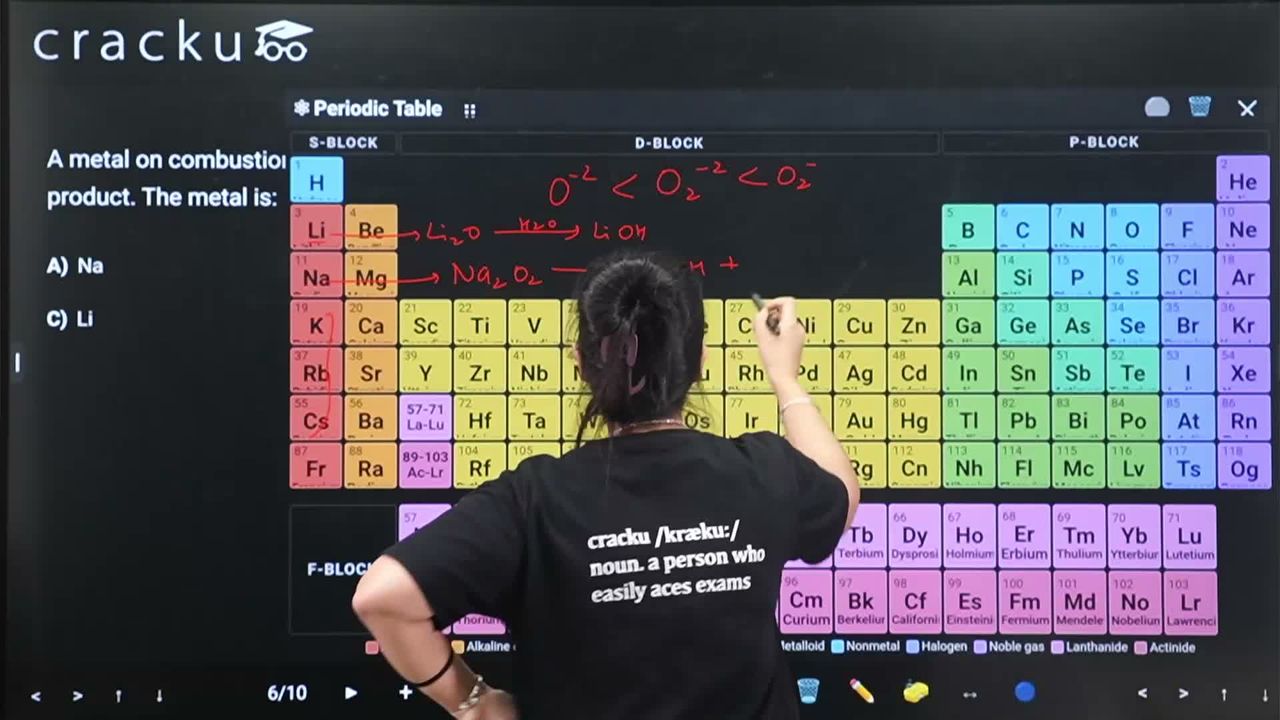
A metal on combustion in excess air forms X. X upon hydrolysis with water yields $$H_2O_2$$ and $$O_2$$ along with another product. The metal is:
First, we recall the general behaviour of alkali-metal oxides. The possible oxides obtained on burning an alkali metal $$M$$ in excess air are:
$$M_2O$$ (normal oxide), $$M_2O_2$$ (peroxide), $$MO_2$$ (superoxide).
The nature of the oxide depends on the size of the metal cation. As we move down the group from Li to Cs, the ionic radius increases, and the larger cations can stabilise the larger $$O_2^-$$ superoxide ion more easily. Hence:
$$\text{Li} \longrightarrow \text{oxide}\;(Li_2O),$$
$$\text{Na} \longrightarrow \text{peroxide}\;(Na_2O_2),$$
$$\text{K},\;\text{Rb},\;\text{Cs} \longrightarrow \text{superoxide}\;(KO_2,\;RbO_2,\;CsO_2).$$
Now, the question states that the oxide $$X$$ on hydrolysis with water gives $$H_2O_2$$ and $$O_2$$ along with another product. Let us write the general hydrolysis reaction for a superoxide:
$$2\,MO_2 + 2\,H_2O \;\longrightarrow\; 2\,MOH + H_2O_2 + O_2.$$
Here we clearly see both $$H_2O_2$$ and $$O_2$$ appearing simultaneously, exactly as described. Thus, $$X$$ must be a superoxide $$MO_2$$.
Among the given metals, the one that most readily forms a superoxide on combustion in excess air is rubidium (Rb). Lithium (Li) forms only the normal oxide, sodium (Na) forms mainly the peroxide, magnesium (Mg) is not an alkali metal at all, while rubidium, being large, stabilises the superoxide $$RbO_2$$.
Therefore the metal whose combustion product fits the data is rubidium.
Hence, the correct answer is Option D.
Was this solution helpful?
Click on the Email ☝️ to Watch the Video Solution
Create a FREE account and get:
_1.webp)

Educational materials for JEE preparation

Ask our AI anything

AI can make mistakes. Please verify important information.
AI can make mistakes. Please verify important information.
