
Join Our JEE Preparation Group
Prep with like-minded aspirants; Get access to free daily tests and study material.
Sign in
Please select an account to continue using cracku.in
↓ →
Join Our JEE Preparation Group
Prep with like-minded aspirants; Get access to free daily tests and study material.
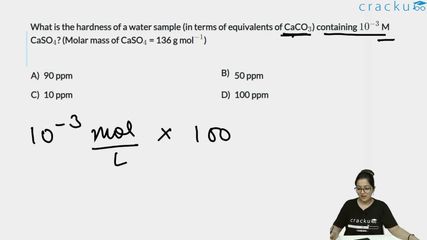
What is the hardness of a water sample (in terms of equivalents of CaCO$$_3$$) containing $$10^{-3}$$ M CaSO$$_4$$? (Molar mass of CaSO$$_4$$ = 136 g mol$$^{-1}$$)
We are given that the water sample contains calcium sulphate with a molarity of $$10^{-3}\,\text{M}$$. A solution’s hardness is always reported as an equivalent concentration of calcium carbonate ($$ \text{CaCO}_3 $$) expressed in parts per million (ppm), which numerically equals milligrams of $$\text{CaCO}_3$$ per litre of water.
First we note that one formula unit of $$\text{CaSO}_4$$ furnishes exactly one $$\text{Ca}^{2+}$$ ion in solution, and likewise one formula unit of $$\text{CaCO}_3$$ also supplies one $$\text{Ca}^{2+}$$ ion. Therefore, the amount (in moles) of $$\text{CaSO}_4$$ present may be directly equated, mole for mole, to the amount of $$\text{CaCO}_3$$ that would give the same concentration of calcium ions.
We have the molarity
$$ C_{\text{CaSO}_4}=10^{-3}\,\text{mol L}^{-1}. $$
To convert this molarity into an equivalent mass of $$\text{CaCO}_3$$ per litre we multiply the molarity by the molar mass of $$\text{CaCO}_3$$. The molar mass of $$\text{CaCO}_3$$ is
$$ M_{\text{CaCO}_3}=40 + 12 + 16\times3 = 100\ \text{g mol}^{-1}. $$
Using the relationship
$$ \text{mg L}^{-1} = (\text{mol L}^{-1})\times(\text{g mol}^{-1})\times10^3, $$
we substitute the known values:
$$ \begin{aligned} \text{Hardness (as CaCO}_3\text{)} &= \left(10^{-3}\ \text{mol L}^{-1}\right)\times\left(100\ \text{g mol}^{-1}\right)\times10^{3}\ \frac{\text{mg}}{\text{g}} \\ &= 10^{-3}\times100\times10^{3}\ \text{mg L}^{-1} \\ &= 0.1\times10^{3}\ \text{mg L}^{-1} \\ &= 100\ \text{mg L}^{-1}. \end{aligned} $$
Because $$1\ \text{mg L}^{-1}$$ of $$\text{CaCO}_3$$ is numerically equal to 1 ppm, the calculated value of $$100\ \text{mg L}^{-1}$$ corresponds to
$$ 100\ \text{ppm}. $$
Hence, the correct answer is Option D.
Was this solution helpful?
Click on the Email ☝️ to Watch the Video Solution
Create a FREE account and get:
_1.webp)

Educational materials for JEE preparation

Ask our AI anything

AI can make mistakes. Please verify important information.
AI can make mistakes. Please verify important information.
