
Join Our JEE Preparation Group
Prep with like-minded aspirants; Get access to free daily tests and study material.
Sign in
Please select an account to continue using cracku.in
↓ →
Join Our JEE Preparation Group
Prep with like-minded aspirants; Get access to free daily tests and study material.
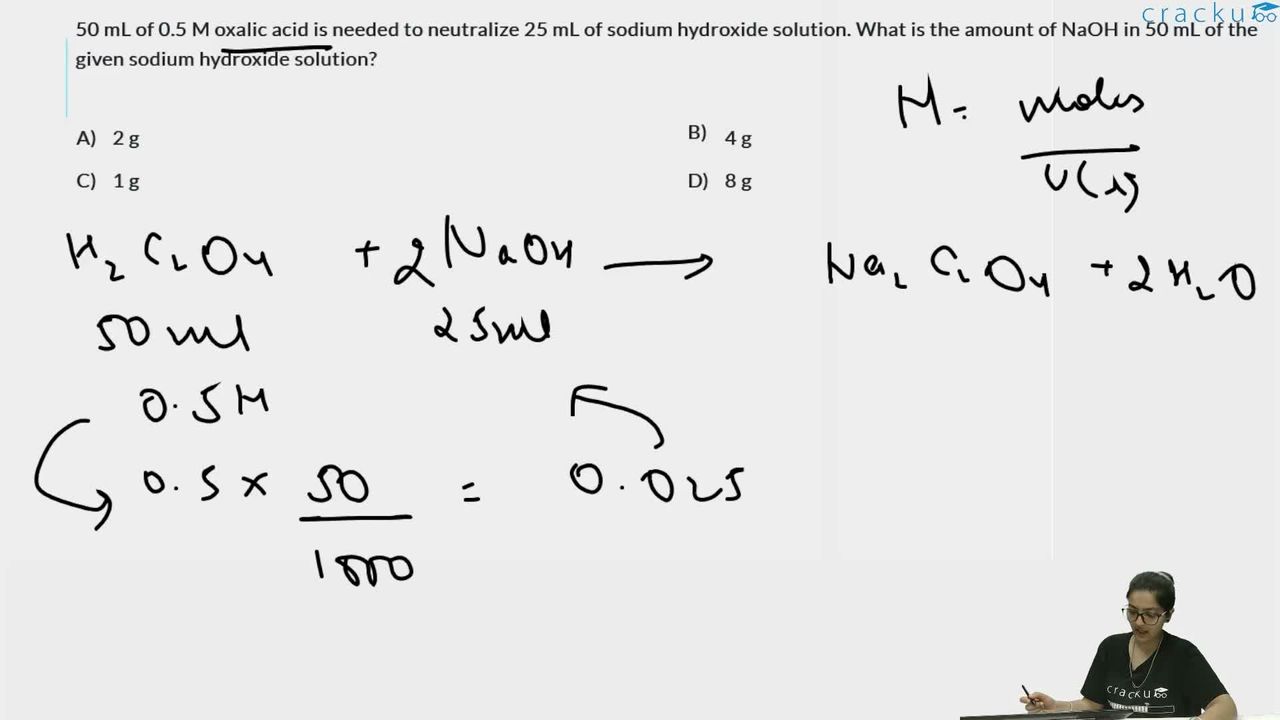
50 mL of 0.5 M oxalic acid is needed to neutralize 25 mL of sodium hydroxide solution. What is the amount of NaOH in 50 mL of the given sodium hydroxide solution?
First, we note the balanced neutralisation reaction between oxalic acid and sodium hydroxide. The formula of oxalic acid is $$\mathrm{H_2C_2O_4}$$, which is dibasic, meaning it contains two acidic hydrogens. The reaction with NaOH is written as
$$\mathrm{H_2C_2O_4 + 2\,NaOH \;\longrightarrow\; Na_2C_2O_4 + 2\,H_2O}$$
From this equation we clearly see that
1 mole of $$\mathrm{H_2C_2O_4}$$ reacts with 2 moles of $$\mathrm{NaOH}$$.
Now we calculate the number of moles of oxalic acid actually taken in the experiment. We have a volume of $$50\ \text{mL}$$ of oxalic-acid solution and its molarity is $$0.5\ \text{M}$$. Remember the definition of molarity:
$$\text{Molarity (M)} = \dfrac{\text{moles of solute}}{\text{volume of solution in litres}}.$$
Re-arranging gives
$$\text{moles of solute} = \text{Molarity} \times \text{Volume in litres}.$$
The given volume is $$50\ \text{mL} = 50 \times 10^{-3}\ \text{L} = 0.05\ \text{L}.$$ Substituting the numbers, we obtain
$$\text{moles of } \mathrm{H_2C_2O_4} = 0.5\ \text{M} \times 0.05\ \text{L} = 0.025\ \text{mol}.$$
Using the stoichiometric ratio from the balanced equation, we convert these moles of oxalic acid to moles of NaOH:
$$\mathrm{H_2C_2O_4 : NaOH = 1 : 2}$$
So
$$\text{moles of NaOH} = 2 \times 0.025\ \text{mol} = 0.050\ \text{mol}.$$
These $$0.050\ \text{mol}$$ of NaOH are present in the $$25\ \text{mL}$$ (that is $$0.025\ \text{L}$$) of the sodium-hydroxide solution that was taken for titration. We can therefore determine the molarity of the NaOH solution. Using the molarity formula again, but this time solving for molarity:
$$\text{Molarity of NaOH} = \dfrac{\text{moles of NaOH}}{\text{volume in litres}} = \dfrac{0.050\ \text{mol}}{0.025\ \text{L}} = 2\ \text{M}.$$
Now the question asks for the amount (mass) of NaOH in $$50\ \text{mL}$$ of this solution. First we find the number of moles present in that volume. The volume $$50\ \text{mL}$$ equals $$0.050\ \text{L}$$, so
$$\text{moles in } 50\ \text{mL} = 2\ \text{M} \times 0.050\ \text{L} = 0.10\ \text{mol}.$$
Finally, we convert moles to grams. The molar mass of NaOH is calculated as
$$M(\mathrm{NaOH}) = 23\ (\text{Na}) + 16\ (\text{O}) + 1\ (\text{H}) = 40\ \text{g mol}^{-1}.$$
Hence, the mass is
$$\text{mass} = \text{moles} \times \text{molar mass} = 0.10\ \text{mol} \times 40\ \text{g mol}^{-1} = 4\ \text{g}.$$
Hence, the correct answer is Option B.
Was this solution helpful?
Click on the Email ☝️ to Watch the Video Solution
Create a FREE account and get:
_1.webp)

Educational materials for JEE preparation

Ask our AI anything

AI can make mistakes. Please verify important information.
AI can make mistakes. Please verify important information.
