
Join Our JEE Preparation Group
Prep with like-minded aspirants; Get access to free daily tests and study material.
Sign in
Please select an account to continue using cracku.in
↓ →
Join Our JEE Preparation Group
Prep with like-minded aspirants; Get access to free daily tests and study material.
Two solids dissociate as follows: $$A(s) \rightleftharpoons B(g) + C(g)$$; $$K_{P_1} = x$$ atm$$^2$$, $$D(s) \rightleftharpoons C(g) + E(g)$$; $$K_{P_2} = y$$ atm$$^2$$. The total pressure when both the solids dissociate simultaneously is:
We have two separate heterogeneous equilibria in the same closed vessel at a fixed temperature. Because the reactants are solids, their activities are unity and do not appear in the equilibrium-constant expressions.
The first dissociation is
$$A(s)\;\rightleftharpoons\;B(g)+C(g)$$
For this reaction the equilibrium constant (in terms of partial pressures) is defined as
$$K_{P_1}=P_B\,P_C=x\text{ atm}^2\;.$$
The second dissociation is
$$D(s)\;\rightleftharpoons\;C(g)+E(g)$$
and its constant is
$$K_{P_2}=P_C\,P_E=y\text{ atm}^2\;.$$
Let the extent of the first dissociation be $$\lambda_1$$ moles, and that of the second be $$\lambda_2$$ moles. Because each reaction produces its two gaseous products in a 1 : 1 ratio, the numbers of moles of the three gases that finally appear are
$$n_B=\lambda_1,\qquad n_C=\lambda_1+\lambda_2,\qquad n_E=\lambda_2\;.$$
If the vessel has volume $$V$$ and the temperature is $$T$$, the partial pressures are proportional to the mole numbers:
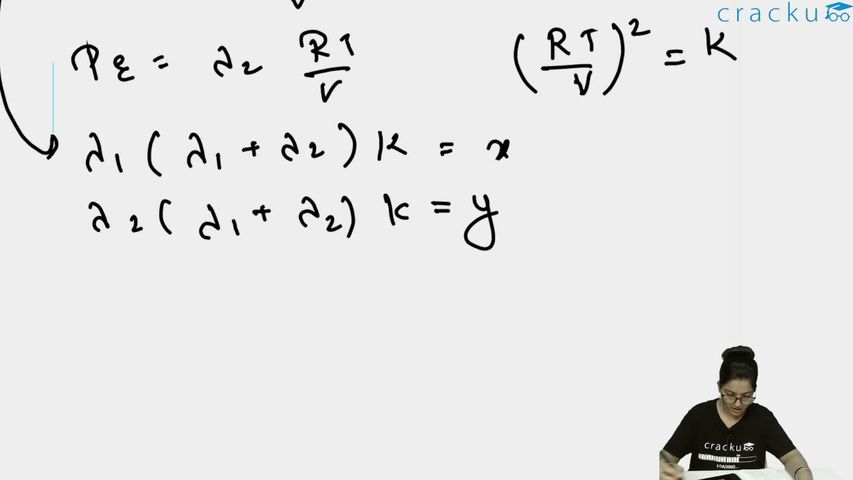
$$P_B=\lambda_1\frac{RT}{V},\qquad P_C=(\lambda_1+\lambda_2)\frac{RT}{V},\qquad P_E=\lambda_2\frac{RT}{V}\;.$$
For compactness set $$k=\left(\frac{RT}{V}\right)^2\;.$$
Substituting the expressions for the partial pressures into the two equilibrium-constant equations gives
$$\lambda_1(\lambda_1+\lambda_2)k=x\;,$$
$$\lambda_2(\lambda_1+\lambda_2)k=y\;.$$
Dividing the first of these equations by the second eliminates the common factor $$\lambda_1+\lambda_2$$ and yields a simple ratio:
$$\frac{\lambda_1}{\lambda_2}=\frac{x}{y}\;. \quad -(1)$$
Add the two equilibrium equations term by term:
$$\bigl[\lambda_1(\lambda_1+\lambda_2)+\lambda_2(\lambda_1+\lambda_2)\bigr]k=x+y\;,$$
$$\Rightarrow (\lambda_1+\lambda_2)^2k=x+y\;,$$
$$\Rightarrow (\lambda_1+\lambda_2)^2=\frac{x+y}{k}\;,$$
$$\Rightarrow \lambda_1+\lambda_2=\sqrt{\frac{x+y}{k}}\;. \quad -(2)$$
Now calculate the partial pressure of the common gas $$C$$:
$$P_C=(\lambda_1+\lambda_2)\frac{RT}{V} =\sqrt{\frac{x+y}{k}}\;\frac{RT}{V} =\sqrt{\frac{x+y}{(RT/V)^2}}\;\frac{RT}{V} =\sqrt{x+y}\;.$$
Finally, the total pressure in the vessel is the sum of the three partial pressures:
$$P_{\text{total}} =P_B+P_C+P_E =\lambda_1\frac{RT}{V}+(\lambda_1+\lambda_2)\frac{RT}{V}+\lambda_2\frac{RT}{V}$$
$$\qquad=2(\lambda_1+\lambda_2)\frac{RT}{V}=2P_C=2\sqrt{x+y}\;\text{atm}\;.$$
Hence, the correct answer is Option D.
Was this solution helpful?
Click on the Email ☝️ to Watch the Video Solution
Create a FREE account and get:
_1.webp)

Educational materials for JEE preparation

Ask our AI anything

AI can make mistakes. Please verify important information.
AI can make mistakes. Please verify important information.
