
Join Our JEE Preparation Group
Prep with like-minded aspirants; Get access to free daily tests and study material.
Sign in
Please select an account to continue using cracku.in
↓ →
Join Our JEE Preparation Group
Prep with like-minded aspirants; Get access to free daily tests and study material.
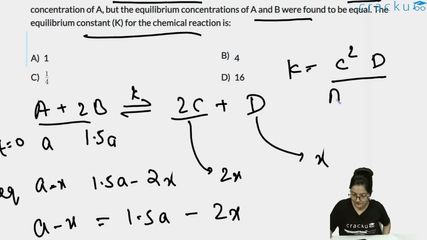
In a chemical reaction, $$A + 2B \xrightleftharpoons{K} 2C + D$$, the initial concentration of B was 1.5 times the concentration of A, but the equilibrium concentrations of A and B were found to be equal. The equilibrium constant (K) for the chemical reaction is:
We have the reversible reaction $$A + 2B \;\xrightleftharpoons{K}\; 2C + D$$.
Let the initial concentration of $$A$$ be $$a\;{\rm mol\,L^{-1}}$$. According to the statement, the initial concentration of $$B$$ is $$1.5$$ times that of $$A$$, so it is $$1.5a\;{\rm mol\,L^{-1}}$$. At the start, no product is present, so $$[C]_0 = 0$$ and $$[D]_0 = 0$$.
Suppose that by the time equilibrium is reached, an amount $$x\;{\rm mol\,L^{-1}}$$ of $$A$$ has reacted. From the stoichiometry of the balanced equation, the changes in concentration can be tabulated as follows:
$$ \begin{array}{c|c|c|c|c} & A & B & C & D\\ \hline \text{Initial} & a & 1.5a & 0 & 0\\ \text{Change} & -x & -2x & +2x & +x\\ \text{Equilibrium} & a-x & 1.5a-2x & 2x & x \end{array} $$
We are further told that at equilibrium the concentrations of $$A$$ and $$B$$ are equal. Thus
$$a - x \;=\; 1.5a - 2x.$$
Solving this equality step by step:
First, bring like terms together: $$-x + 2x = 1.5a - a.$$
So $$x = 0.5a.$$
Substituting $$x = 0.5a$$ back into the equilibrium concentrations, we obtain
$$[A]_{\text{eq}} = a - x = a - 0.5a = 0.5a,$$
$$[B]_{\text{eq}} = 1.5a - 2x = 1.5a - 2(0.5a) = 1.5a - a = 0.5a,$$
$$[C]_{\text{eq}} = 2x = 2(0.5a) = a,$$
$$[D]_{\text{eq}} = x = 0.5a.$$
Now we recall the expression for the equilibrium constant $$K_c$$ for a reaction of the type $$\alpha A + \beta B \rightleftharpoons \gamma C + \delta D$$, namely
$$K_c = \dfrac{[C]^\gamma [D]^\delta}{[A]^\alpha [B]^\beta}.$$
For our specific reaction $$A + 2B \rightleftharpoons 2C + D$$, the formula becomes
$$K = \dfrac{[C]^2\,[D]}{[A]\,[B]^2}.$$
Substituting the equilibrium concentrations we have just found,
$$ \begin{aligned} K &= \dfrac{(a)^2\,(0.5a)}{(0.5a)\,(0.5a)^2}\\[4pt] &= \dfrac{a^2 \times 0.5a}{0.5a \times 0.25a^2}\\[4pt] &= \dfrac{0.5\,a^3}{0.125\,a^3}\\[4pt] &= \dfrac{0.5}{0.125}\\[4pt] &= 4. \end{aligned} $$
The $$a^3$$ terms cancel out completely, leaving a pure number. Thus the numerical value of the equilibrium constant is $$K = 4$$.
Hence, the correct answer is Option B.
Was this solution helpful?
Click on the Email ☝️ to Watch the Video Solution
Create a FREE account and get:
_1.webp)

Educational materials for JEE preparation

Ask our AI anything

AI can make mistakes. Please verify important information.
AI can make mistakes. Please verify important information.
