
Join Our JEE Preparation Group
Prep with like-minded aspirants; Get access to free daily tests and study material.
Sign in
Please select an account to continue using cracku.in
↓ →
Join Our JEE Preparation Group
Prep with like-minded aspirants; Get access to free daily tests and study material.
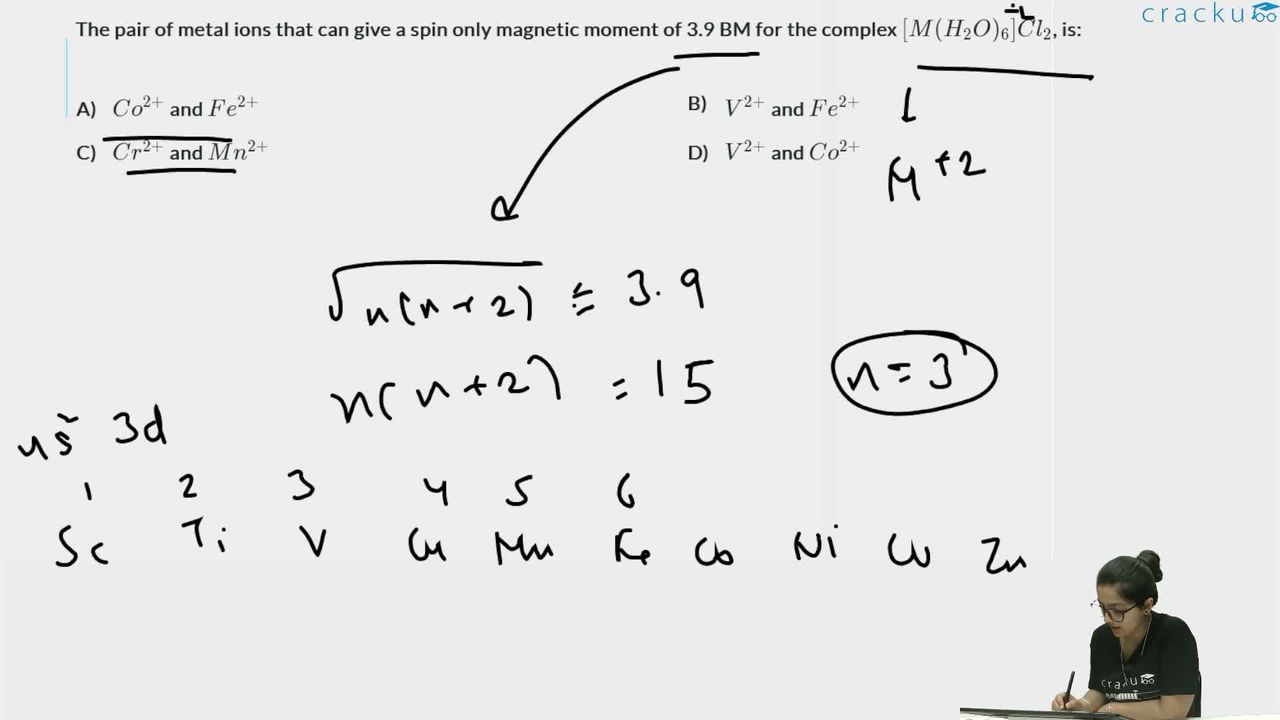
The pair of metal ions that can give a spin only magnetic moment of 3.9 BM for the complex $$[M(H_2O)_6]Cl_2$$, is:
For an octahedral complex of the type $$[M(H_2O)_6]Cl_2$$ we first note that each chloride ion is the counter-ion and water is the only ligand present. Water ($$H_2O$$) is a weak‐field ligand, so the complex formed is expected to be high-spin in every case. Because there are two chloride ions outside the bracket, the metal must be in the $$+2$$ oxidation state.
The spin-only magnetic moment is given by the well-known formula
$$\mu_{\text{spin only}}=\sqrt{n(n+2)}\;{\rm BM}$$
where $$n$$ is the number of unpaired electrons in the d-orbitals of the metal ion.
The question states that the observed moment is $$3.9\;{\rm BM}$$. We equate this to the formula to find the corresponding $$n$$:
$$3.9\;{\rm BM}\;\approx\;\sqrt{n(n+2)}\;{\rm BM}$$
Squaring both sides,
$$3.9^{2}\;\approx\;n(n+2)$$
$$15.21\;\approx\;n^{2}+2n$$
Trial with small integer values shows
$$n=3\;:\;n(n+2)=3\times5=15\quad(\sqrt{15}\approx3.87\;{\rm BM})$$
The calculated value $$3.87\;{\rm BM}$$ matches the required $$3.9\;{\rm BM}$$ very well, so we need exactly $$n=3$$ unpaired electrons.
Now we inspect each metal ion in the $$+2$$ state, remembering that the complex is high-spin.
1. $$V^{2+}$$
Atomic number of V = 23. Neutral configuration: $$[Ar]\,4s^{2}3d^{3}$$.
Removing two electrons (first from 4s, then 3d) gives $$[Ar]\,3d^{3}$$.
High-spin $$3d^{3}$$ means one electron in each of the three t2g orbitals and none in eg, so
$$n=3\quad\Rightarrow\quad\mu=\sqrt{3(3+2)}=\sqrt{15}=3.87\;{\rm BM}$$
2. $$Co^{2+}$$
Atomic number of Co = 27. Neutral configuration: $$[Ar]\,4s^{2}3d^{7}$$.
After losing two 4s electrons: $$[Ar]\,3d^{7}$$.
In a high-spin octahedral field the filling is $$t_{2g}^{5}e_{g}^{2}$$. Let us count the unpaired electrons explicitly:
• For $$t_{2g}^{5}$$ the first three electrons occupy the three orbitals singly (3 unpaired).
The fourth pairs with one of them (now 2 unpaired).
The fifth pairs with another (now 1 unpaired).
• The next two electrons go into the two eg orbitals singly, adding 2 more unpaired.
Total $$n = 1 + 2 = 3$$.
Again
$$\mu=\sqrt{3(3+2)}=3.87\;{\rm BM}$$
3. $$Fe^{2+}$$
$$[Ar]\,3d^{6}$$ high-spin gives $$t_{2g}^{4}e_{g}^{2}$$ with $$n=4$$ unpaired, leading to $$\mu=\sqrt{4(4+2)}\approx4.90\;{\rm BM}$$, which is too high.
4. $$Cr^{2+}$$
$$[Ar]\,3d^{4}$$ high-spin has $$n=4$$ unpaired, again too high.
5. $$Mn^{2+}$$
$$[Ar]\,3d^{5}$$ high-spin has $$n=5$$ unpaired, giving $$\mu\approx5.92\;{\rm BM}$$, also too high.
Thus the only ions that individually provide exactly three unpaired electrons, and therefore a spin-only moment of about $$3.9\;{\rm BM}$$, are $$V^{2+}$$ and $$Co^{2+}$$. These appear together in option D.
Hence, the correct answer is Option D.
Was this solution helpful?
Click on the Email ☝️ to Watch the Video Solution
Create a FREE account and get:
Educational materials for JEE preparation

Ask our AI anything

AI can make mistakes. Please verify important information.
AI can make mistakes. Please verify important information.

_1.webp)
