
Join Our JEE Preparation Group
Prep with like-minded aspirants; Get access to free daily tests and study material.
Sign in
Please select an account to continue using cracku.in
↓ →
Join Our JEE Preparation Group
Prep with like-minded aspirants; Get access to free daily tests and study material.
Iodine reacts with concentrated $$HNO_3$$ to yield Y along with other products. The oxidation state of iodine in Y, is:
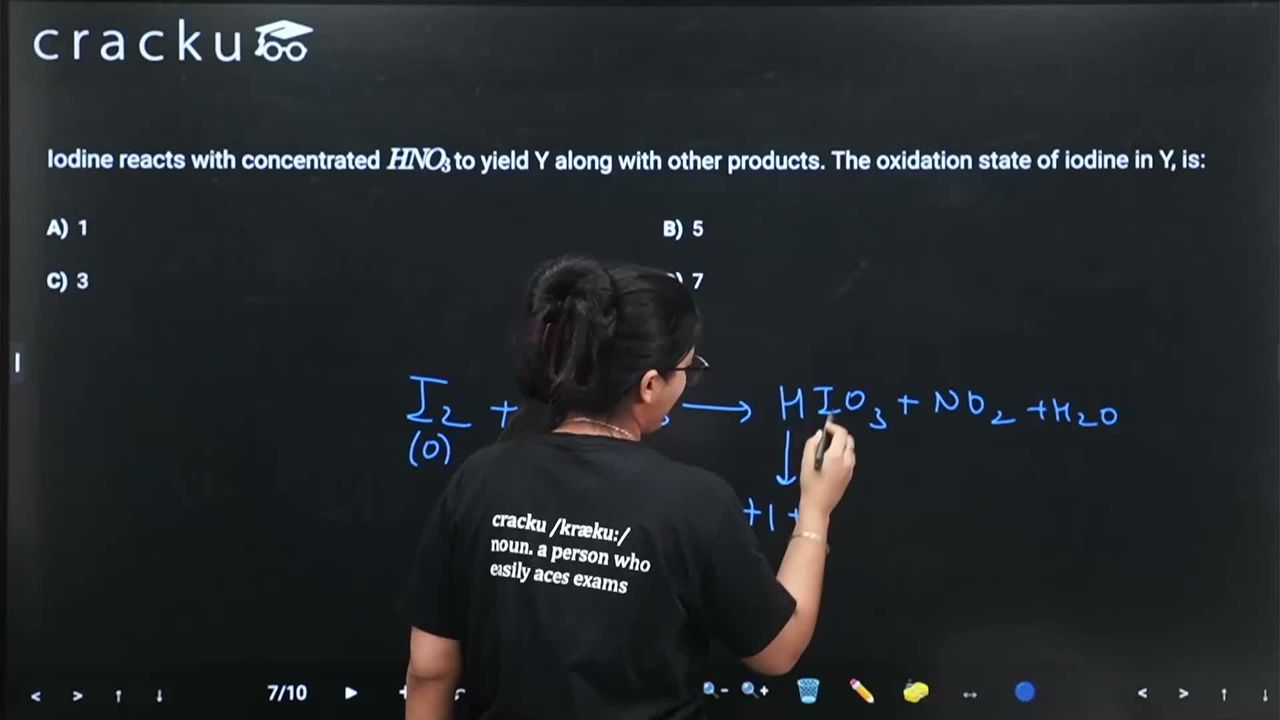
We begin by recalling that concentrated $$\mathrm{HNO_3}$$ is a very strong oxidising agent. When elemental iodine $$\mathrm{I_2}$$ is treated with hot, concentrated $$\mathrm{HNO_3}$$, the nitric acid oxidises iodine and is itself reduced. The principal oxidation product of iodine in this medium is iodic acid, whose formula is $$\mathrm{HIO_3}$$. We symbolise this reaction as
$$\mathrm{I_2 + 10\,HNO_3 \longrightarrow 2\,HIO_3 + 10\,NO_2 + 4\,H_2O}$$
In this balanced redox equation, the species labelled $$\mathrm{HIO_3}$$ is our substance $$Y$$. The problem now reduces to finding the oxidation state of iodine in $$\mathrm{HIO_3}$$.
To do this, we apply the fundamental rule for oxidation-state calculations: the algebraic sum of oxidation numbers of all atoms in a neutral molecule must equal zero. Let us denote the unknown oxidation state of iodine by $$x$$. Then, recognising that hydrogen carries an oxidation state of $$+1$$ and oxygen carries $$-2$$, we write
$$ \underbrace{(+1)}_{\text{H}} \;+\; \underbrace{(x)}_{\text{I}} \;+\; 3\!\times\!\underbrace{(-2)}_{\text{O}} \;=\; 0 . $$
Now we perform the step-by-step algebra:
$$ +1 + x + 3(-2) = 0 $$
$$ +1 + x - 6 = 0 $$
$$ x - 5 = 0 $$
$$ x = +5 $$
Thus, the oxidation state of iodine in $$\mathrm{HIO_3}$$ (species $$Y$$) is $$+5$$.
Hence, the correct answer is Option B.
Was this solution helpful?
Click on the Email ☝️ to Watch the Video Solution
Create a FREE account and get:
_1.webp)

Educational materials for JEE preparation

Ask our AI anything

AI can make mistakes. Please verify important information.
AI can make mistakes. Please verify important information.
