
Join Our JEE Preparation Group
Prep with like-minded aspirants; Get access to free daily tests and study material.
Sign in
Please select an account to continue using cracku.in
↓ →
Join Our JEE Preparation Group
Prep with like-minded aspirants; Get access to free daily tests and study material.
The metal's d-orbitals that are directly facing the ligands in $$K_3[Co(CN)_6]$$ are:
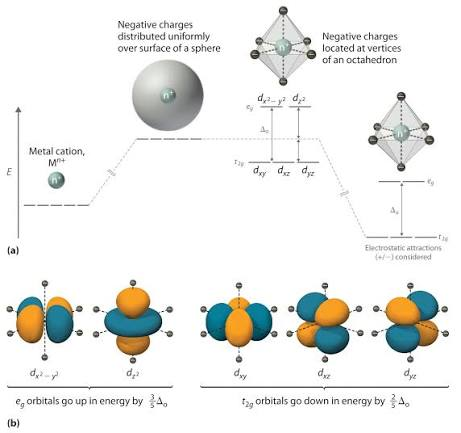
We start by identifying the geometry of the coordination entity $$[Co(CN)_6]^{3-}$$ that is present in the salt $$K_3[Co(CN)_6]$$. With six monodentate ligands (the cyanide ions) around a single metal centre, the well-known VSEPR and crystal-field considerations tell us that such a species adopts an octahedral shape. In an octahedral arrangement every ligand comes in along one of the positive or negative coordinate axes, that is, along $$+x,\,-x,\,+y,\,-y,\,+z$$ and $$-z$$ directions.
Now we recall the basic crystal-field splitting picture for an octahedral field. First we state the result:
In an octahedral crystal field the five metal $$d$$ orbitals split into two sets: $$ t_{2g}: \; d_{xy},\, d_{xz},\, d_{yz} \qquad\text{and}\qquad e_g: \; d_{x^2-y^2},\, d_{z^2}. $$
The physical reason for this splitting can be described as follows. The incoming ligand electron pairs create regions of negative charge directly along the coordinate axes. Therefore any metal orbital that points its electron density right along those axes will experience a larger electrostatic repulsion and will be raised to a higher energy. Conversely, an orbital that points between the axes will experience a smaller repulsion and stay at lower energy.
Next we examine the orientation of each $$d$$ orbital. We write them explicitly to see their lobes:
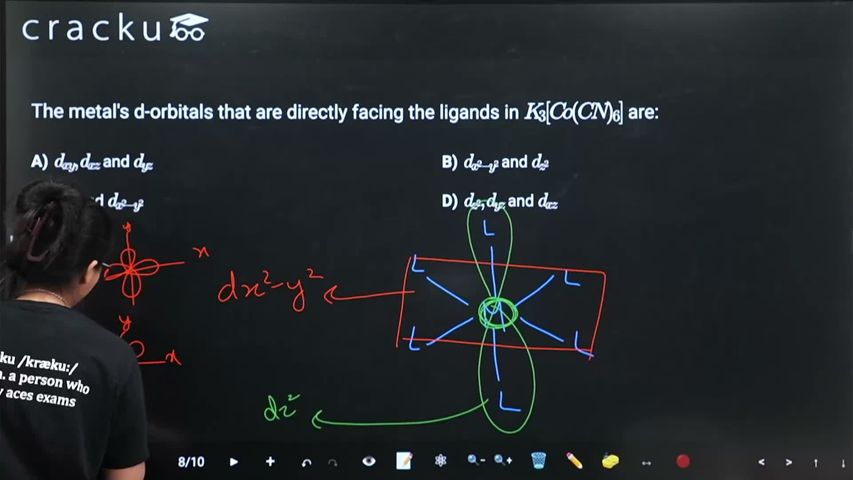
Because in $$[Co(CN)_6]^{3-}$$ the ligands sit on the coordinate axes, the orbitals whose lobes coincide with those axes are said to be “directly facing” the ligands, receiving the strongest repulsion and hence belonging to the higher-energy $$e_g$$ set. As just established, those orbitals are $$d_{x^2-y^2}$$ and $$d_{z^2}$$.
Therefore the pair of metal $$d$$ orbitals that directly face the cyanide ligands in $$K_3[Co(CN)_6]$$ are $$d_{x^2-y^2}$$ and $$d_{z^2}$$.
Hence, the correct answer is Option B.
Was this solution helpful?
Click on the Email ☝️ to Watch the Video Solution
Create a FREE account and get:
_1.webp)

Educational materials for JEE preparation

Ask our AI anything

AI can make mistakes. Please verify important information.
AI can make mistakes. Please verify important information.
