
Join Our JEE Preparation Group
Prep with like-minded aspirants; Get access to free daily tests and study material.
Sign in
Please select an account to continue using cracku.in
↓ →
Join Our JEE Preparation Group
Prep with like-minded aspirants; Get access to free daily tests and study material.
The volume of gas A is twice than that of gas B. The compressibility factor of gas A is thrice than that of gas B at same temperature. What are the pressures of the gases for equal number of moles?
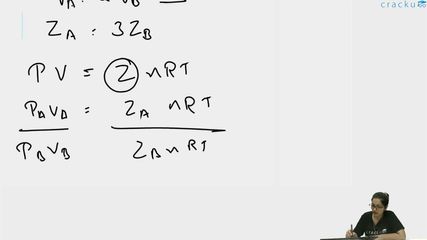
For real gases we use the relation $$PV = Z\,nRT$$, where $$P$$ is pressure, $$V$$ is volume, $$n$$ is the number of moles, $$T$$ is the temperature, $$R$$ is the universal gas constant and $$Z$$ is the compressibility factor.
Both gases A and B are taken at the same temperature and contain an equal number of moles, so $$n$$, $$R$$ and $$T$$ are common to both. Hence we can write
$$P_A V_A = Z_A nRT \quad\text{and}\quad P_B V_B = Z_B nRT.$$
Dividing the first equation by the second we get
$$\dfrac{P_A V_A}{P_B V_B} = \dfrac{Z_A}{Z_B}.$$
The problem tells us that the volume of gas A is twice that of gas B, so $$V_A = 2V_B.$$ Substituting this into the ratio gives
$$\dfrac{P_A (2V_B)}{P_B V_B} = \dfrac{Z_A}{Z_B}.$$
Simplifying the left side, $$V_B$$ cancels:
$$\dfrac{2P_A}{P_B} = \dfrac{Z_A}{Z_B}.$$
We are also told that the compressibility factor of gas A is three times that of gas B, so $$Z_A = 3Z_B.$$ Substituting this value yields
$$\dfrac{2P_A}{P_B} = \dfrac{3Z_B}{Z_B} = 3.$$
Now solving for the ratio of the pressures, we have
$$2P_A = 3P_B.$$
This is exactly the relation asked for between the two pressures. Hence, the correct answer is Option A.
Was this solution helpful?
Click on the Email ☝️ to Watch the Video Solution
Create a FREE account and get:
_1.webp)

Educational materials for JEE preparation

Ask our AI anything

AI can make mistakes. Please verify important information.
AI can make mistakes. Please verify important information.
