
Join Our JEE Preparation Group
Prep with like-minded aspirants; Get access to free daily tests and study material.
Sign in
Please select an account to continue using cracku.in
↓ →
Join Our JEE Preparation Group
Prep with like-minded aspirants; Get access to free daily tests and study material.
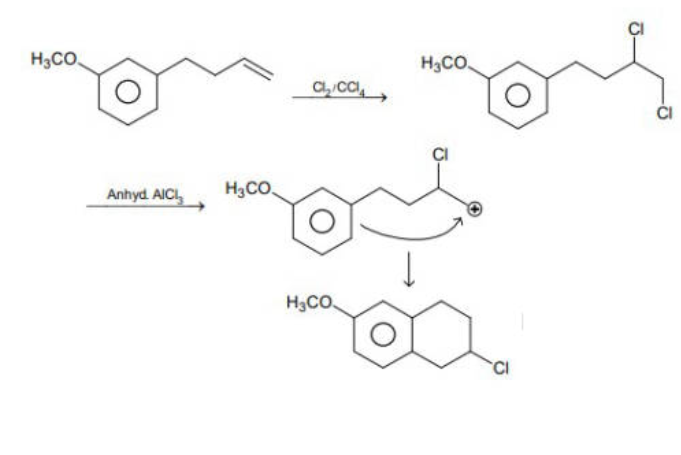
Carbocation Generation:
In the presence of a Lewis acid or under ionizing conditions, the chloride leaving group ($$\text{Cl}^\ominus$$) departs from the saturated ring, generating a reactive carbocation intermediate.
Intramolecular Electrophilic Attack:
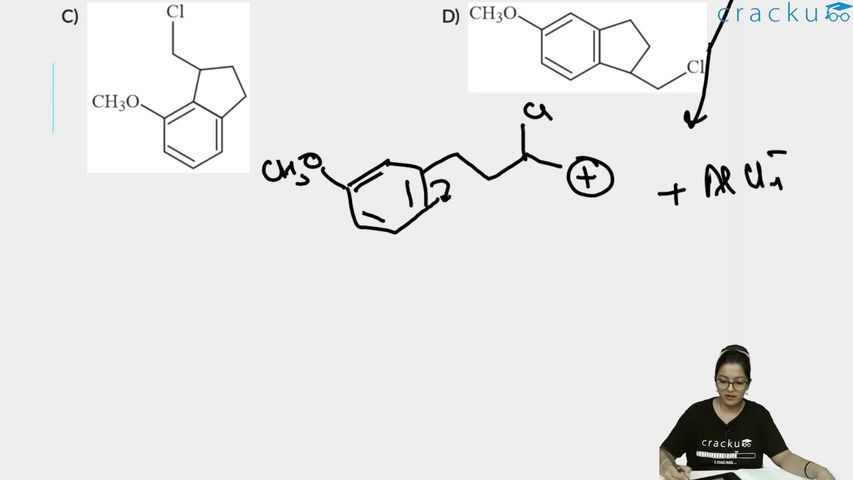
The electron-rich aromatic ring, heavily activated by the strongly electron-donating methoxy group ($$\text{--OCH}_3$$) via resonance ($$+R$$ effect), acts as an internal nucleophile. The aromatic system attacks the newly formed carbocation center to close a new ring, generating the localized arenium ion (Wheland intermediate) shown on the right side of the scheme.
Deprotonation (Aromatization):
As explicitly highlighted by the step labeled $$-\text{H}^\oplus$$, the arenium intermediate undergoes rapid loss of a proton from the site of substitution. This deprotonation removes the localized positive charge and restores the fully conjugated, thermodynamically stable aromatic system.
The loss of the proton ($$\text{H}^\oplus$$) from the arenium intermediate regenerates the aromaticity of the benzene ring containing the methoxy substituent, completing the intramolecular cyclization framework.
Answer: Option B
Was this solution helpful?
Click on the Email ☝️ to Watch the Video Solution
Create a FREE account and get:
_1.webp)

Educational materials for JEE preparation

Ask our AI anything

AI can make mistakes. Please verify important information.
AI can make mistakes. Please verify important information.

