
Join Our JEE Preparation Group
Prep with like-minded aspirants; Get access to free daily tests and study material.
Sign in
Please select an account to continue using cracku.in
↓ →
Join Our JEE Preparation Group
Prep with like-minded aspirants; Get access to free daily tests and study material.
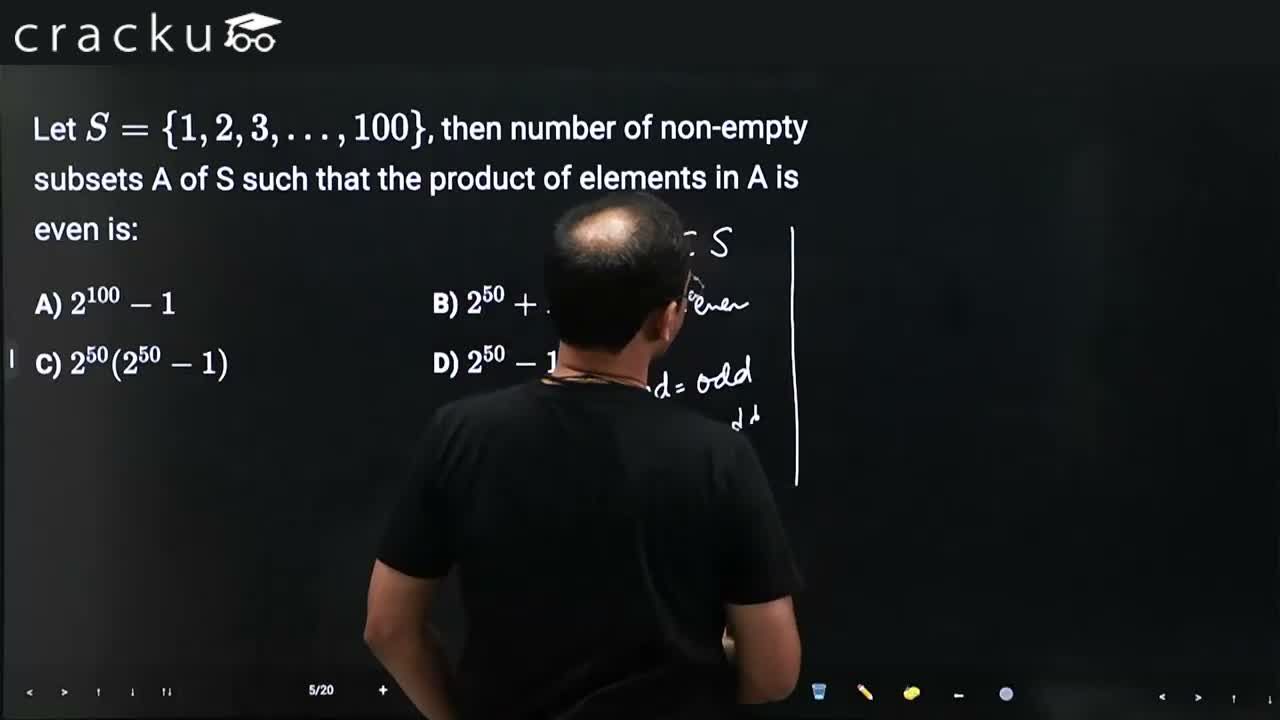
Let $$S = \{1, 2, 3, \ldots, 100\}$$, then number of non-empty subsets A of S such that the product of elements in A is even is:
First, recall the basic counting fact: if a finite set has $$n$$ elements, the total number of all its subsets (including the empty set) is $$2^{\,n}$$, because each element may be either “chosen” or “not chosen”.
Here the set is $$S=\{1,2,3,\ldots ,100\}$$, so $$|S| = 100$$. Hence, by the above fact, the total number of subsets of $$S$$ is $$2^{100}$$. Among these, exactly one subset is empty, so the number of non-empty subsets is
$$2^{100}-1.$$
We are asked to count those non-empty subsets $$A$$ whose product of elements is even. A product of integers is even as soon as at least one factor is even. Therefore a subset has an even product precisely when it contains at least one even number. The complementary situation is that the subset contains no even numbers at all, i.e. it is formed entirely of odd numbers; such a subset will clearly have an odd product.
So, instead of counting the “even-product” subsets directly, we count all non-empty subsets and subtract the non-empty subsets that consist only of odd numbers. This is the classic “complement counting” technique.
Among the first 100 positive integers, exactly half are odd and half are even, because the list alternates parity. Concretely, the odd numbers are
$$1,3,5,\ldots ,99,$$
and there are $$50$$ of them. Let us call this set of odd numbers $$O$$, so $$|O| = 50$$.
Applying again the subset-counting fact, the total number of subsets of $$O$$ (including the empty subset) is $$2^{50}$$. Excluding the empty subset, the number of non-empty subsets of $$O$$ is therefore
$$2^{50}-1.$$
Every such subset uses only odd elements, hence its product is odd. Consequently, the count $$2^{50}-1$$ is exactly the number of non-empty subsets of $$S$$ having an odd product.
Now we subtract these from the total number of non-empty subsets to obtain the desired count of even-product subsets:
$$ \begin{aligned} \text{Number of even-product subsets} &= (2^{100}-1) \;-\; (2^{50}-1)\\[4pt] &= 2^{100}-1-2^{50}+1\\[4pt] &= 2^{100}-2^{50}.\\ \end{aligned} $$
This difference can be factorised by taking $$2^{50}$$ common:
$$ 2^{100}-2^{50} = 2^{50}\left(2^{100-50}-1\right) = 2^{50}\left(2^{50}-1\right). $$
Thus the number of non-empty subsets of $$S$$ whose product is even is $$2^{50}\bigl(2^{50}-1\bigr)$$.
Looking at the given options, this expression matches Option C.
Hence, the correct answer is Option C.
Was this solution helpful?
Click on the Email ☝️ to Watch the Video Solution
Create a FREE account and get:
_1.webp)

Educational materials for JEE preparation

Ask our AI anything

AI can make mistakes. Please verify important information.
AI can make mistakes. Please verify important information.
