
Join Our JEE Preparation Group
Prep with like-minded aspirants; Get access to free daily tests and study material.
Sign in
Please select an account to continue using cracku.in
↓ →
Join Our JEE Preparation Group
Prep with like-minded aspirants; Get access to free daily tests and study material.
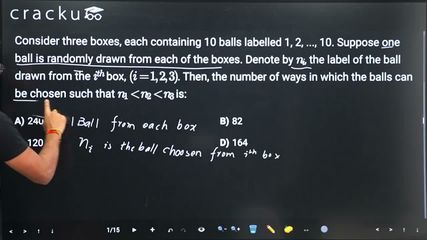
Consider three boxes, each containing 10 balls labelled 1, 2, ..., 10. Suppose one ball is randomly drawn from each of the boxes. Denote by $$n_i$$, the label of the ball drawn from the $$i^{th}$$ box, $$(i = 1, 2, 3)$$. Then, the number of ways in which the balls can be chosen such that $$n_1 < n_2 < n_3$$ is:
We have three separate boxes, and each box contains the ten balls whose labels are the integers $$1,2,3,\ldots ,10$$. From every box exactly one ball is drawn, so we obtain an ordered triple of labels $$(n_1,n_2,n_3)$$ where $$n_1$$ comes from the first box, $$n_2$$ from the second, and $$n_3$$ from the third.
The condition given in the question is $$n_1 \lt n_2 \lt n_3$$. Because of the two “<” symbols, the three numbers must be pairwise distinct; no two of them can be equal.
Since each box possesses every label from 1 to 10, once we decide which number is to be $$n_1$$, which is to be $$n_2$$, and which is to be $$n_3$$, there is exactly one way to realise that decision: we simply pick the ball carrying that label from the corresponding box. Thus the whole counting problem reduces to selecting the three distinct labels themselves.
So we only have to count the number of different subsets of three distinct numbers that can be taken from the set $$\{1,2,3,\ldots ,10\}$$. After choosing the three numbers, we automatically arrange them in increasing order to become $$n_1,n_2,n_3$$, so no further permutations are possible or needed.
To count such subsets we use the combination formula. The number of ways of choosing $$r$$ objects out of $$n$$ distinct objects is given by $$ \binom{n}{r}=\frac{n!}{r!\,(n-r)!}. $$ Here $$n=10$$ and $$r=3$$, hence $$ \binom{10}{3}= \frac{10!}{3!\,(10-3)!}= \frac{10\times9\times8\times7!}{3\times2\times1\times7!}= \frac{720}{6}=120. $$
Therefore there are $$120$$ favourable triples $$(n_1,n_2,n_3)$$ satisfying $$n_1 \lt n_2 \lt n_3$$.
Hence, the correct answer is Option C.
Was this solution helpful?
Click on the Email ☝️ to Watch the Video Solution
Create a FREE account and get:
_1.webp)

Educational materials for JEE preparation

Ask our AI anything

AI can make mistakes. Please verify important information.
AI can make mistakes. Please verify important information.
