
Join Our JEE Preparation Group
Prep with like-minded aspirants; Get access to free daily tests and study material.
Sign in
Please select an account to continue using cracku.in
↓ →
Join Our JEE Preparation Group
Prep with like-minded aspirants; Get access to free daily tests and study material.
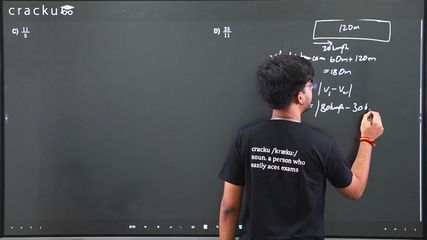
A passenger train of length 60 m travels at a speed of 80 km/hr. Another freight train of length 120 m travels at a speed of 30 km/hr. The ratio of times taken by the passenger train to completely cross the freight train when: (i) they are moving in the same direction, and (ii) in the opposite directions is:
We have a passenger train whose length is $$L_1 = 60\text{ m}$$ and a freight train whose length is $$L_2 = 120\text{ m}$$. For the passenger train to clear the freight train completely, the front end of the passenger train must travel a distance equal to the sum of their lengths, so the distance to be covered is
$$D = L_1 + L_2 = 60\text{ m} + 120\text{ m} = 180\text{ m}.$$
The speeds given are
Passenger train speed $$V_1 = 80\text{ km h}^{-1},$$
Freight train speed $$V_2 = 30\text{ km h}^{-1}.$$
First, convert each speed from kilometres per hour to metres per second using the relation $$1\text{ km h}^{-1} = \tfrac{5}{18}\text{ m s}^{-1}.$$ We therefore obtain
$$V_1 = 80 \times \frac{5}{18} = \frac{400}{18} = \frac{200}{9}\text{ m s}^{-1},$$
$$V_2 = 30 \times \frac{5}{18} = \frac{150}{18} = \frac{25}{3}\text{ m s}^{-1}.$$
Now we analyse the two required cases.
Case (i): Trains moving in the same direction. The relative speed is the difference of the individual speeds, because one train is moving away from the other in the same direction. Hence, using the formula $$\text{Relative speed (same direction)} = |V_1 - V_2|,$$ we have
$$V_{\text{rel, same}} = \left|\frac{200}{9} - \frac{25}{3}\right| = \left|\frac{200}{9} - \frac{75}{9}\right| = \frac{125}{9}\text{ m s}^{-1}.$$
The time taken is distance divided by this relative speed, i.e. $$t_1 = \frac{D}{V_{\text{rel, same}}} = \frac{180}{\frac{125}{9}} = 180 \times \frac{9}{125} = \frac{1620}{125} = \frac{324}{25}\text{ s}.$$
Case (ii): Trains moving in opposite directions. Now the relative speed is the sum of the individual speeds, because the trains approach each other head-on. Using the formula $$\text{Relative speed (opposite direction)} = V_1 + V_2,$$ we have
$$V_{\text{rel, opp}} = \frac{200}{9} + \frac{25}{3} = \frac{200}{9} + \frac{75}{9} = \frac{275}{9}\text{ m s}^{-1}.$$
The corresponding time is $$t_2 = \frac{D}{V_{\text{rel, opp}}} = \frac{180}{\frac{275}{9}} = 180 \times \frac{9}{275} = \frac{1620}{275} = \frac{324}{55}\text{ s}.$$
We now need the ratio of the two times. Since both times involve the same distance, the ratio simplifies neatly:
$$\frac{t_1}{t_2} = \frac{\frac{324}{25}}{\frac{324}{55}} = \frac{324}{25} \times \frac{55}{324} = \frac{55}{25} = \frac{11}{5}.$$
Thus, the required ratio of the times is $$\frac{11}{5}.$$
Hence, the correct answer is Option C.
Was this solution helpful?
Click on the Email ☝️ to Watch the Video Solution
Create a FREE account and get:
_1.webp)

Educational materials for JEE preparation

Ask our AI anything

AI can make mistakes. Please verify important information.
AI can make mistakes. Please verify important information.
