
Join Our JEE Preparation Group
Prep with like-minded aspirants; Get access to free daily tests and study material.
Sign in
Please select an account to continue using cracku.in
↓ →
Join Our JEE Preparation Group
Prep with like-minded aspirants; Get access to free daily tests and study material.
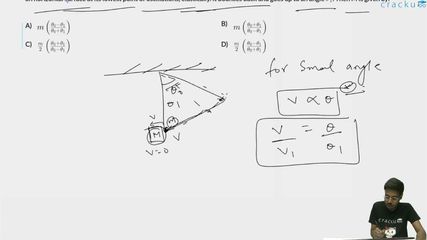
A simple pendulum, made of a string of length $$l$$ and a bob of mass $$m$$, is released from a small angle $$\theta_0$$. It strikes a block of mass $$M$$, kept on horizontal surface at its lowest point of oscillations, elastically. It bounces back and goes up to an angle $$\theta_1$$. Then M is given by:
We begin with the bob of the simple pendulum. It is released from the angle $$\theta_0$$ and swings down to the lowest point. At the lowest point all the gravitational potential energy that the bob lost has been converted into kinetic energy.
The change in height of the bob, measured vertically from the lowest point, is obtained from the length $$l$$ of the pendulum. For a small angle $$\theta$$ we use the approximation $$\cos\theta \simeq 1-\dfrac{\theta^2}{2}$$, so
$$h = l - l\cos\theta \;\; \Longrightarrow \;\; h \simeq l\left(1-\Bigl[1-\frac{\theta^2}{2}\Bigr]\right)=\frac{l\theta^2}{2}.$$
Hence the speed of the bob just before impact is found from conservation of mechanical energy:
$$\frac{1}{2}m v_0^2 = m g h \;\; \Longrightarrow \;\; \frac{1}{2}m v_0^2 = m g \Bigl(\frac{l\theta_0^2}{2}\Bigr)$$
which simplifies to
$$v_0 = \sqrt{g l}\;\theta_0.$$ (Note that $$\sqrt{g l}$$ is the natural speed scale of a simple pendulum.)
The bob collides elastically with a block of mass $$M$$ that is initially at rest on a horizontal surface. For a perfectly elastic, one-dimensional collision we invoke the standard results (stated first):
For masses $$m$$ and $$M$$ with initial velocities $$u_m$$ and $$u_M$$, the velocities just after collision are $$ v_m = \frac{m-M}{m+M}\;u_m + \frac{2M}{m+M}\;u_M , \qquad v_M = \frac{2m}{m+M}\;u_m + \frac{M-m}{m+M}\;u_M . $$
Because the block is initially at rest, we put $$u_m = v_0$$ and $$u_M = 0$$, giving
$$ v_1 = \frac{m-M}{m+M}\;v_0, \qquad V = \frac{2m}{m+M}\;v_0, $$
where $$v_1$$ is the speed of the bob just after the collision (now moving upward) and $$V$$ is the speed of the block.
After the bounce the bob rises to an angle $$\theta_1$$ before momentarily coming to rest. Using the same energy argument as before, the kinetic energy at the lowest point converts back into gravitational potential energy at that maximum angle:
$$\frac{1}{2}m v_1^2 = m g \Bigl(\frac{l\theta_1^2}{2}\Bigr).$$
Solving for $$v_1$$ yields
$$v_1 = \sqrt{g l}\;\theta_1.$$
We now have two expressions for $$v_1$$, so we equate them:
$$\sqrt{g l}\;\theta_1 = \frac{m-M}{m+M}\;\Bigl(\sqrt{g l}\;\theta_0\Bigr).$$
Dividing both sides by $$\sqrt{g l}$$ gives a purely algebraic relation:
$$\theta_1 = \frac{m-M}{m+M}\;\theta_0.$$ Multiplying both sides by $$(m+M)$$ we obtain $$m\theta_1 + M\theta_1 = m\theta_0 - M\theta_0.$$
Gathering the terms that contain $$M$$ on the left and those that contain $$m$$ on the right:
$$M\theta_1 + M\theta_0 = m\theta_0 - m\theta_1.$$ Factoring the common symbols, $$M(\theta_1+\theta_0) = m(\theta_0-\theta_1).$$
Finally, solving for $$M$$ we divide both sides by $$(\theta_1+\theta_0)$$:
$$ M = m\;\frac{\theta_0 - \theta_1}{\theta_0 + \theta_1}. $$
This matches Option A.
Hence, the correct answer is Option A.
Was this solution helpful?
Click on the Email ☝️ to Watch the Video Solution
Create a FREE account and get:
_1.webp)

Educational materials for JEE preparation

Ask our AI anything

AI can make mistakes. Please verify important information.
AI can make mistakes. Please verify important information.
