
Join Our JEE Preparation Group
Prep with like-minded aspirants; Get access to free daily tests and study material.
Sign in
Please select an account to continue using cracku.in
↓ →
Join Our JEE Preparation Group
Prep with like-minded aspirants; Get access to free daily tests and study material.
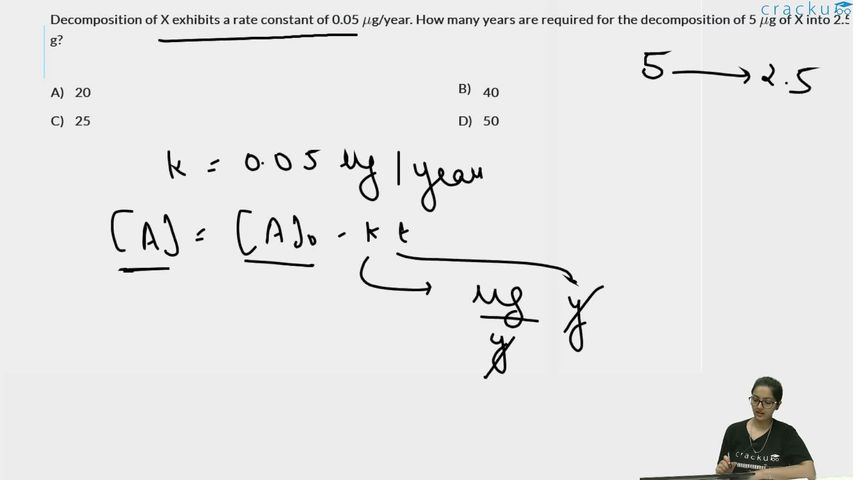
Decomposition of X exhibits a rate constant of 0.05 $$\mu$$g/year. How many years are required for the decomposition of 5 $$\mu$$g of X into 2.5 $$\mu$$g?
We begin by recalling that the rate equation for a zero-order reaction is given by the formula $$\text{Rate}=k$$, where $$k$$ is the zero-order rate constant. For such reactions the integrated form is
$$[A]=[A]_0-k\,t,$$
where $$[A]_0$$ is the initial amount (or concentration) of the substance, $$[A]$$ is the amount remaining after time $$t$$, and $$k$$ has units of amount per time. The presence of units $$\mu\text{g\,year}^{-1}$$ for $$k$$ confirms that the decomposition of X follows zero-order kinetics.
We are told that the initial mass of X is $$[A]_0=5\;\mu\text{g}$$ and the mass after decomposition is $$[A]=2.5\;\mu\text{g}$$. The rate constant is $$k=0.05\;\mu\text{g\,year}^{-1}$$. Substituting these values into the integrated equation, we get
$$2.5 = 5 - 0.05\,t.$$
Now we isolate $$t$$ step by step. First subtract $$5$$ from both sides:
$$2.5 - 5 = -0.05\,t.$$
This simplifies to
$$-2.5 = -0.05\,t.$$
Next divide both sides by $$-0.05$$ to solve for $$t$$:
$$t = \dfrac{-2.5}{-0.05}.$$
Carrying out the division in the numerator and denominator, we have
$$t = \dfrac{2.5}{0.05}.$$
Since $$2.5 \div 0.05 = 50$$, we arrive at
$$t = 50\;\text{years}.$$
Thus, 50 years are required for the decomposition of 5 $$\mu\text{g}$$ of X to 2.5 $$\mu\text{g}$$.
Hence, the correct answer is Option D.
Was this solution helpful?
Click on the Email ☝️ to Watch the Video Solution
Create a FREE account and get:
_1.webp)

Educational materials for JEE preparation

Ask our AI anything

AI can make mistakes. Please verify important information.
AI can make mistakes. Please verify important information.
