
Join Our JEE Preparation Group
Prep with like-minded aspirants; Get access to free daily tests and study material.
Sign in
Please select an account to continue using cracku.in
↓ →
Join Our JEE Preparation Group
Prep with like-minded aspirants; Get access to free daily tests and study material.
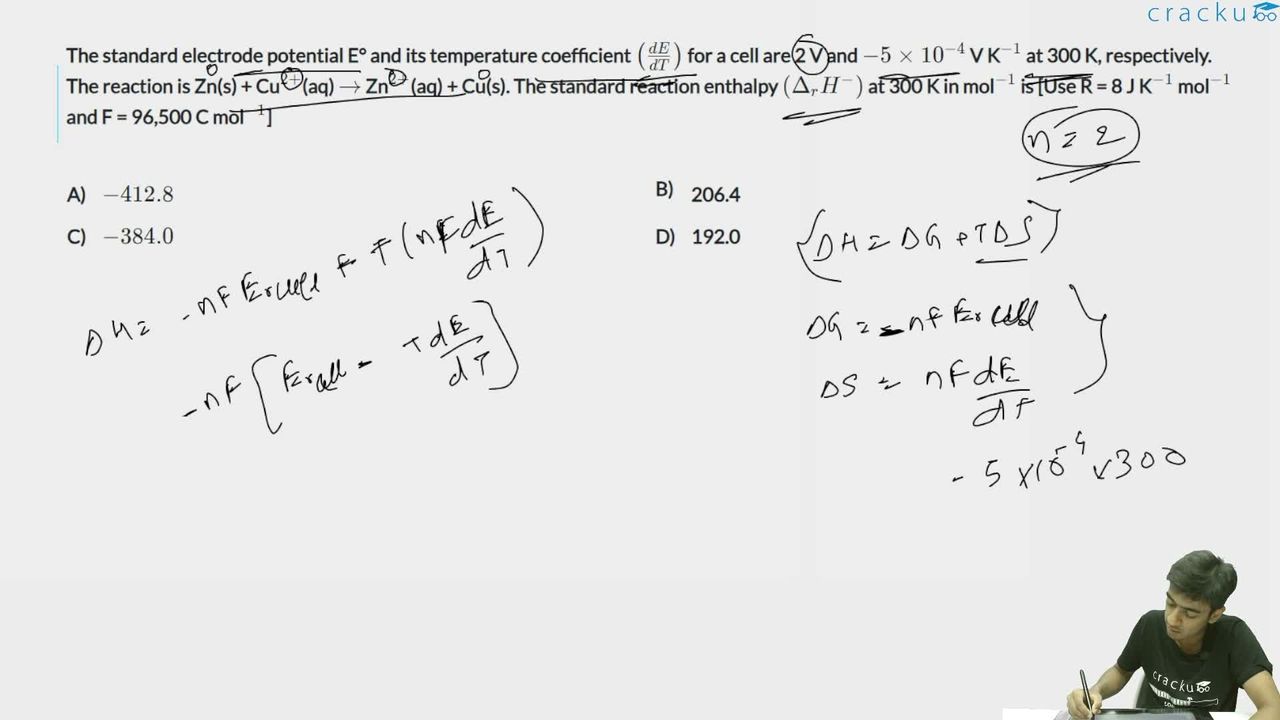
The standard electrode potential E° and its temperature coefficient $$\left(\frac{dE}{dT}\right)$$ for a cell are 2 V and $$-5 \times 10^{-4}$$ V K$$^{-1}$$ at 300 K, respectively. The reaction is Zn(s) + Cu$$^{2+}$$(aq) $$\to$$ Zn$$^{2+}$$(aq) + Cu(s). The standard reaction enthalpy $$(\Delta_r H^-)$$ at 300 K in mol$$^{-1}$$ is [Use R = 8 J K$$^{-1}$$ mol$$^{-1}$$ and F = 96,500 C mol$$^{-1}$$]
To find the standard reaction enthalpy (H), we use the thermodynamic relationship for electrochemical cells:
H = G + T * S
Where:
Substituting G and S into the main equation gives: H = -n * F * E + T * [n * F * (dE/dT)]
Factoring out (-n * F) simplifies the equation to: H = -n * F * [E - T * (dE/dT)]
Now substitute this back into the bracket:
Was this solution helpful?
Click on the Email ☝️ to Watch the Video Solution
Create a FREE account and get:
_1.webp)

Educational materials for JEE preparation

Ask our AI anything

AI can make mistakes. Please verify important information.
AI can make mistakes. Please verify important information.
