
Join Our JEE Preparation Group
Prep with like-minded aspirants; Get access to free daily tests and study material.
Sign in
Please select an account to continue using cracku.in
↓ →
Join Our JEE Preparation Group
Prep with like-minded aspirants; Get access to free daily tests and study material.
We wish to evaluate the indefinite integral
$$\int \cos(\ln x)\,dx.$$
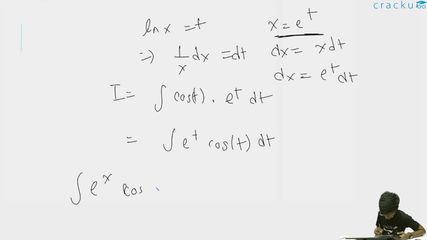
Because the argument of the cosine is $$\ln x$$, it is natural to remove the logarithm by the substitution
$$t=\ln x.$$
Then we have $$x=e^{t}$$ and, differentiating both sides,
$$dx=\frac{dx}{dt}\,dt=e^{t}\,dt=x\,dt.$$
Substituting these expressions into the integral gives
$$\int \cos(\ln x)\,dx=\int \cos(t)\,(e^{t}\,dt)=\int e^{t}\cos t\,dt.$$
Now we have to integrate the product $$e^{t}\cos t$$. For such integrals the standard method is integration by parts applied twice, but an even quicker way is to recall the known formula
$$\int e^{at}\cos(bt)\,dt=\frac{e^{at}}{a^{2}+b^{2}}\left(a\cos bt+b\sin bt\right)+C.$$
In our case $$a=1$$ and $$b=1$$, so
$$\int e^{t}\cos t\,dt=\frac{e^{t}}{1^{2}+1^{2}}\Bigl(1\cdot\cos t+1\cdot\sin t\Bigr)+C =\frac{e^{t}}{2}\bigl(\cos t+\sin t\bigr)+C.$$
Now we back-substitute $$t=\ln x$$ and $$e^{t}=x$$:
$$\int \cos(\ln x)\,dx=\frac{x}{2}\left(\cos(\ln x)+\sin(\ln x)\right)+C.$$
Hence, the correct answer is Option D.
Was this solution helpful?
Click on the Email ☝️ to Watch the Video Solution
Create a FREE account and get:
_1.webp)

Educational materials for JEE preparation

Ask our AI anything

AI can make mistakes. Please verify important information.
AI can make mistakes. Please verify important information.
