
Join Our JEE Preparation Group
Prep with like-minded aspirants; Get access to free daily tests and study material.
Sign in
Please select an account to continue using cracku.in
↓ →
Join Our JEE Preparation Group
Prep with like-minded aspirants; Get access to free daily tests and study material.
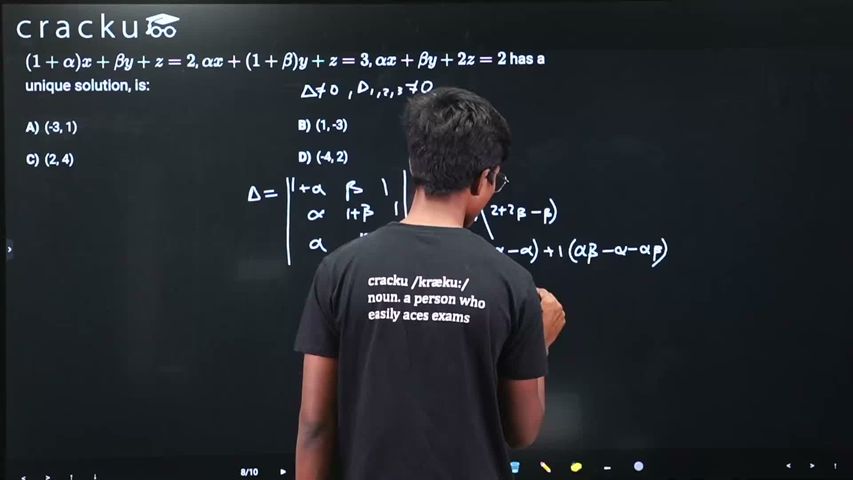
An ordered pair $$(\alpha, \beta)$$ for which the system of linear equations $$(1 + \alpha)x + \beta y + z = 2$$, $$\alpha x + (1 + \beta)y + z = 3$$, $$\alpha x + \beta y + 2z = 2$$ has a unique solution, is:
We wish to decide for which ordered pair $$(\alpha ,\beta)$$ the following system
$$\begin{aligned} (1+\alpha)x+\beta y+ z &= 2,\\ \alpha x+(1+\beta)y+ z &= 3,\\ \alpha x+\beta y+2z &= 2 \end{aligned}$$
admits a unique solution. In linear algebra, a $$3\times3$$ system has a unique solution exactly when the determinant of its coefficient matrix is non-zero.
First, we write the coefficient matrix:
$$\begin{bmatrix} 1+\alpha & \beta & 1\\ \alpha & 1+\beta & 1\\ \alpha & \beta & 2 \end{bmatrix}.$$
Its determinant will be denoted by $$\Delta$$. Using the rule for a $$3\times3$$ determinant,
$$\Delta=\,(1+\alpha)\Bigl[(1+\beta)\cdot2-1\cdot\beta\Bigr] -\beta\Bigl[\alpha\cdot2-1\cdot\alpha\Bigr] +1\Bigl[\alpha\beta-\alpha(1+\beta)\Bigr].$$
Now we evaluate each bracket one by one.
First bracket: $$ (1+\beta)\cdot2-1\cdot\beta=2(1+\beta)-\beta=2+2\beta-\beta=2+\beta. $$
Second bracket: $$ \alpha\cdot2-1\cdot\alpha=2\alpha-\alpha=\alpha. $$
Third bracket: $$ \alpha\beta-\alpha(1+\beta)=\alpha\beta-\alpha-\alpha\beta=-\alpha. $$
Substituting these back gives
$$\Delta=(1+\alpha)(2+\beta)-\beta(\alpha)+1(-\alpha).$$
We expand the first product:
$$ (1+\alpha)(2+\beta)=1\cdot(2+\beta)+\alpha\cdot(2+\beta)=2+\beta+2\alpha+\alpha\beta. $$
Putting everything together,
$$\Delta=\bigl[2+\beta+2\alpha+\alpha\beta\bigr]-\alpha\beta-\alpha =2+\beta+2\alpha+\alpha\beta-\alpha\beta-\alpha.$$ The $$\alpha\beta$$ terms cancel, and $$2\alpha-\alpha=\alpha$$, so
$$\Delta=\alpha+\beta+2. $$
For a unique solution we require $$\Delta\neq0,$$ that is
$$\alpha+\beta+2\neq0.$$ We now test the four given options.
Option A: $$\alpha=-3,\ \beta=1\Rightarrow\alpha+\beta+2=-3+1+2=0.$$ No unique solution.
Option B: $$\alpha=1,\ \beta=-3\Rightarrow\alpha+\beta+2=1-3+2=0.$$ No unique solution.
Option C: $$\alpha=2,\ \beta=4\Rightarrow\alpha+\beta+2=2+4+2=8\neq0.$$ Unique solution exists.
Option D: $$\alpha=-4,\ \beta=2\Rightarrow\alpha+\beta+2=-4+2+2=0.$$ No unique solution.
Only Option C meets the required condition.
Hence, the correct answer is Option C.
Was this solution helpful?
Click on the Email ☝️ to Watch the Video Solution
Create a FREE account and get:
_1.webp)

Educational materials for JEE preparation

Ask our AI anything

AI can make mistakes. Please verify important information.
AI can make mistakes. Please verify important information.
