
Join Our JEE Preparation Group
Prep with like-minded aspirants; Get access to free daily tests and study material.
Sign in
Please select an account to continue using cracku.in
↓ →
Join Our JEE Preparation Group
Prep with like-minded aspirants; Get access to free daily tests and study material.
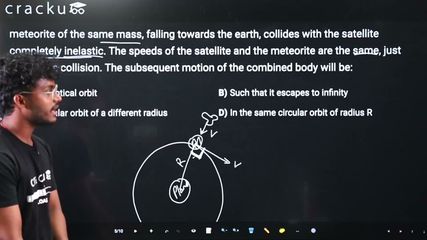
A satellite of mass M is in a circular orbit of radius R about the center of the earth. A meteorite of the same mass, falling towards the earth, collides with the satellite completely inelastic. The speeds of the satellite and the meteorite are the same, just before the collision. The subsequent motion of the combined body will be:
Let the mass of the earth be denoted by $$M_E$$ and the universal gravitational constant by $$G$$. For a satellite of mass $$M$$ moving in a circular orbit of radius $$R$$ the velocity is obtained from the condition for uniform circular motion
$$\displaystyle \frac{G\,M_E\,M}{R^2}= \frac{M v^2}{R}\;\;\Longrightarrow\;\;v=\sqrt{\frac{G\,M_E}{R}}\;.$$
The meteorite has the same mass $$M$$ and, just before impact, is given to have the same speed $$v$$. At the instant of collision the two velocity directions are orthogonal: the satellite velocity is tangential while the meteorite velocity is radially inward. Hence the angle between $$\vec v_{\!s}$$ (satellite) and $$\vec v_{\!m}$$ (meteorite) is $$90^\circ\;.$$
The collision is perfectly inelastic, so the two bodies stick together to form a single body of mass $$2M$$. Because external forces on the system are purely central (gravity through the earth’s centre), the angular momentum about the earth’s centre is conserved during the collision.
Initially, only the satellite possesses angular momentum because the meteorite is moving radially. Using $$\vec L=M\;\vec r\times\vec v$$ with $$r=R$$ we have
$$L_i = M\,R\,v\;.$$
After the collision the linear momenta add vectorially:
$$\vec p_f = M\vec v_{\!s}+M\vec v_{\!m} = M(\vec v_{\!s}+\vec v_{\!m}).$$
Since the two velocities are at right angles and equal in magnitude, their vector sum has magnitude
$$|\vec v_{\!s}+\vec v_{\!m}| = v\sqrt{2}\;.$$
The velocity of the fused body (mass $$2M$$) is therefore
$$\vec v'=\frac{\vec p_f}{2M}= \frac{\vec v_{\!s}+\vec v_{\!m}}{2},\qquad |\vec v'|=\frac{v\sqrt{2}}{2}= \frac{v}{\sqrt2}\;.$$
Because $$\vec v'$$ bisects the right angle between the original velocities, it makes $$45^\circ$$ with the tangent. Its tangential and radial components are each
$$v_t=\frac{v}{2},\qquad v_r=\frac{v}{2}\;.$$
The conserved angular momentum after collision equals
$$L_f = 2M\,R\,v_t = 2M\,R\left(\frac{v}{2}\right)=M\,R\,v=L_i\;,$$
so angular momentum conservation is satisfied.
The specific (per-unit-mass) angular momentum of the combined body is
$$h=\frac{L_f}{2M}=R\,v_t = R\left(\frac{v}{2}\right)=\frac{R\,v}{2}\;.$$
Next we evaluate the specific mechanical energy $$\varepsilon=\dfrac{v'^2}{2}-\dfrac{G\,M_E}{R}\;.$$ Using $$v'^2=\dfrac{v^2}{2}$$ and $$v^2=\dfrac{G\,M_E}{R}$$ we obtain
$$\varepsilon=\frac{1}{2}\left(\frac{v^2}{2}\right)-\frac{v^2}{1}= \frac{v^2}{4}-v^2=-\frac{3\,v^2}{4}\;.$$
The energy is negative, indicating a bound orbit.
To decide whether the bound orbit is circular or elliptical we employ the standard formula for the eccentricity $$e$$ of a Keplerian orbit expressed in terms of specific energy $$\varepsilon$$ and specific angular momentum $$h$$ :
$$e=\sqrt{\,1+\frac{2\varepsilon h^{2}}{(G\,M_E)^{2}}\,}\;.$$
Because $$v^2=\dfrac{G\,M_E}{R}$$ we write $$G\,M_E = v^2 R\;.$$ Now compute the term inside the square root:
$$\frac{2\varepsilon h^{2}}{(G\,M_E)^{2}} =\frac{2\left(-\dfrac{3v^{2}}{4}\right)\left(\dfrac{R^{2}v^{2}}{4}\right)}{(v^{2}R)^{2}} =\frac{-3R^{2}v^{4}/8}{R^{2}v^{4}} =-\frac{3}{8}\;.$$
Therefore
$$e^{2}=1-\frac{3}{8}=\frac{5}{8}\quad\Longrightarrow\quad e=\sqrt{\frac{5}{8}}<1\;.$$
An eccentricity less than unity but greater than zero corresponds to an ellipse that is not a circle. Thus the fused body of mass $$2M$$ moves in an elliptical orbit whose apogee is at the collision point (radius $$R$$) and whose perigee lies closer to the earth.
Hence, the correct answer is Option A.
Was this solution helpful?
Click on the Email ☝️ to Watch the Video Solution
Create a FREE account and get:
_1.webp)

Educational materials for JEE preparation

Ask our AI anything

AI can make mistakes. Please verify important information.
AI can make mistakes. Please verify important information.
