
Join Our JEE Preparation Group
Prep with like-minded aspirants; Get access to free daily tests and study material.
Sign in
Please select an account to continue using cracku.in
↓ →
Join Our JEE Preparation Group
Prep with like-minded aspirants; Get access to free daily tests and study material.
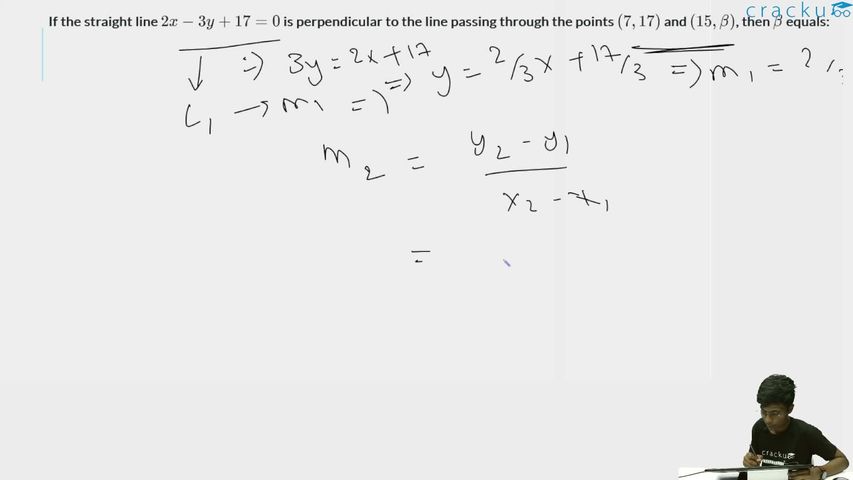
If the straight line $$2x - 3y + 17 = 0$$ is perpendicular to the line passing through the points $$(7, 17)$$ and $$(15, \beta)$$, then $$\beta$$ equals:
We have the first straight line $$2x - 3y + 17 = 0$$. In order to read its slope easily, we bring it to the slope-intercept form $$y = mx + c$$.
Starting with $$2x - 3y + 17 = 0,$$ we isolate the $$y$$-term:
$$-3y = -2x - 17.$$
Dividing every term by $$-3$$ gives
$$y = \frac{2}{3}x + \frac{17}{3}.$$
So the slope of this line is $$m_1 = \frac{2}{3}.$$
Now, two lines are perpendicular when the product of their slopes equals $$-1$$. Hence, if the slope of the required second line is called $$m_2$$, then
$$m_1 \, m_2 = -1 \quad\Longrightarrow\quad \frac{2}{3}\, m_2 = -1.$$
Solving for $$m_2$$:
$$m_2 = -\frac{3}{2}.$$
Next, the second line passes through the two given points $$(7,\,17)$$ and $$(15,\,\beta)$$. By the two-point slope formula, the slope of this line is
$$m_2 = \frac{\beta - 17}{15 - 7}.$$
Simplifying the denominator:
$$m_2 = \frac{\beta - 17}{8}.$$
We have already found that $$m_2 = -\dfrac{3}{2}$$, so we equate the two expressions for the same slope:
$$\frac{\beta - 17}{8} = -\frac{3}{2}.$$
To clear the fractions, we multiply both sides by $$8$$:
$$\beta - 17 = 8 \left(-\frac{3}{2}\right).$$
Calculating the right-hand side:
$$\beta - 17 = -12.$$
Finally, adding $$17$$ to both sides yields
$$\beta = -12 + 17 = 5.$$
Therefore, $$\beta$$ = 5.$$
Hence, the correct answer is Option 3.
Was this solution helpful?
Click on the Email ☝️ to Watch the Video Solution
Create a FREE account and get:
_1.webp)

Educational materials for JEE preparation

Ask our AI anything

AI can make mistakes. Please verify important information.
AI can make mistakes. Please verify important information.
