
Join Our JEE Preparation Group
Prep with like-minded aspirants; Get access to free daily tests and study material.
Sign in
Please select an account to continue using cracku.in
↓ →
Join Our JEE Preparation Group
Prep with like-minded aspirants; Get access to free daily tests and study material.
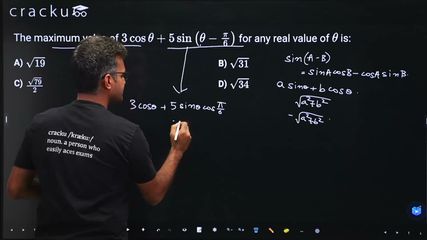
The maximum value of $$3\cos\theta + 5\sin\left(\theta - \frac{\pi}{6}\right)$$ for any real value of $$\theta$$ is:
We have to find the greatest value that the expression
$$E(\theta)=3\cos\theta+5\sin\left(\theta-\frac{\pi}{6}\right)$$
can take for any real $$\theta$$. To compare unlike trigonometric functions, we first express everything in terms of the basic $$\sin\theta$$ and $$\cos\theta$$ functions.
We recall the compound-angle identity for sine:
$$\sin(\alpha-\beta)=\sin\alpha\cos\beta-\cos\alpha\sin\beta.$$
Using this with $$\alpha=\theta$$ and $$\beta=\dfrac{\pi}{6}$$, we write
$$\sin\left(\theta-\frac{\pi}{6}\right)=\sin\theta\cos\frac{\pi}{6}-\cos\theta\sin\frac{\pi}{6}.$$
Now we substitute the exact values $$\cos\dfrac{\pi}{6}=\dfrac{\sqrt3}{2}$$ and $$\sin\dfrac{\pi}{6}=\dfrac12$$:
$$\sin\left(\theta-\frac{\pi}{6}\right)=\sin\theta\left(\frac{\sqrt3}{2}\right)-\cos\theta\left(\frac12\right).$$
Next, we insert this expansion into the original expression:
$$E(\theta)=3\cos\theta+5\Bigg[\sin\theta\left(\frac{\sqrt3}{2}\right)-\cos\theta\left(\frac12\right)\Bigg].$$
Multiplying the 5 inside the brackets term-by-term gives
$$E(\theta)=3\cos\theta+\frac{5\sqrt3}{2}\sin\theta-\frac52\cos\theta.$$
Now we collect the like $$\cos\theta$$ terms together:
$$3\cos\theta-\frac52\cos\theta=\left(3-\frac52\right)\cos\theta=\frac12\cos\theta.$$
Hence the entire expression simplifies to
$$E(\theta)=\frac12\cos\theta+\frac{5\sqrt3}{2}\sin\theta.$$
For clarity, we rename the coefficients:
Let $$A=\frac{5\sqrt3}{2} \quad\text{and}\quad B=\frac12.$$
Thus we have
$$E(\theta)=A\sin\theta+B\cos\theta.$$
There is a standard result for an expression of the form
$$A\sin\theta+B\cos\theta,$$
namely:
It can always be rewritten as
$$\sqrt{A^{2}+B^{2}}\;\sin(\theta+\phi)$$
for some phase angle $$\phi$$ (because $$\sin(\theta+\phi)=\sin\theta\cos\phi+\cos\theta\sin\phi$$). Since the sine function itself is bounded between $$-1$$ and $$1$$, the maximum possible value is precisely the amplitude, i.e.
$$\max\bigl(A\sin\theta+B\cos\theta\bigr)=\sqrt{A^{2}+B^{2}}.$$
Therefore we compute
$$A^{2}+B^{2}=\left(\frac{5\sqrt3}{2}\right)^{2}+\left(\frac12\right)^{2} =\frac{25\cdot3}{4}+\frac{1}{4} =\frac{75+1}{4} =\frac{76}{4} =19.$$
Taking the square root gives
$$\sqrt{A^{2}+B^{2}}=\sqrt{19}.$$
This is the largest value that $$E(\theta)$$ can ever reach for any real $$\theta$$.
Hence, the correct answer is Option A.
Was this solution helpful?
Click on the Email ☝️ to Watch the Video Solution
Create a FREE account and get:
_1.webp)

Educational materials for JEE preparation

Ask our AI anything

AI can make mistakes. Please verify important information.
AI can make mistakes. Please verify important information.
