
Join Our JEE Preparation Group
Prep with like-minded aspirants; Get access to free daily tests and study material.
Sign in
Please select an account to continue using cracku.in
↓ →
Join Our JEE Preparation Group
Prep with like-minded aspirants; Get access to free daily tests and study material.
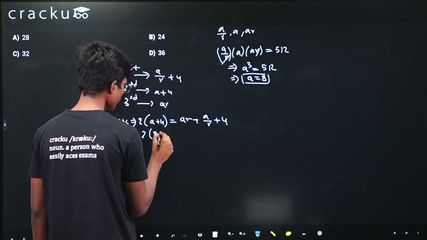
The product of three consecutive terms of a G.P. is 512. If 4 is added to each of the first and the second of these terms, the three terms now form an A.P., then the sum of the original three terms of the given G.P. is:
Let the three consecutive terms of the required geometric progression be written in the symmetric form $$\dfrac{a}{r},\; a,\; ar,$$ where $$a$$ is the middle term and $$r$$ (with $$r\ne 0$$) is the common ratio.
We are first told that the product of these three numbers is $$512$$. Using the property that the product of three consecutive G.P. terms equals the cube of the middle term, we write
$$\left(\dfrac{a}{r}\right)\,a\,(ar)=a^{3}=512.$$
Taking the real cube‐root on both sides, we get
$$a=\sqrt[3]{512}=8.$$
Next, the problem says that if $$4$$ is added to each of the first and the second terms (but not to the third), then the resulting three numbers form an arithmetic progression. So the new triple is
$$\left(\dfrac{a}{r}+4\right),\; (a+4),\; ar.$$
For any three numbers $$x,\,y,\,z$$ to be in A.P., the defining relation is $$2y=x+z.$$ Applying this criterion with the above values, we have
$$2\,(a+4)=\left(\dfrac{a}{r}+4\right)+ar.$$
We already know $$a=8,$$ so substitute $$a=8$$:
$$2\,(8+4)=\left(\dfrac{8}{r}+4\right)+8r.$$
Simplifying step by step, first evaluate the left side:
$$2\times12=24.$$
Hence
$$24=\dfrac{8}{r}+4+8r.$$
Move the constant $$4$$ to the left side:
$$24-4=\dfrac{8}{r}+8r,$$
so
$$20=\dfrac{8}{r}+8r.$$
Divide every term by $$4$$ to make the coefficients smaller:
$$\dfrac{20}{4}=\dfrac{8}{4r}+ \dfrac{8r}{4}\quad\Longrightarrow\quad5=\dfrac{2}{r}+2r.$$
Now multiply through by $$r$$ to clear the denominator:
$$5r=2+2r^{2}.$$
Rearrange all terms to one side to form a quadratic equation:
$$2r^{2}-5r+2=0.$$
Compute the discriminant $$\Delta$$:
$$\Delta=(-5)^{2}-4\cdot2\cdot2=25-16=9.$$
Since $$\Delta=9,$$ the roots are real and are found using the quadratic formula $$r=\dfrac{-b\pm\sqrt{\Delta}}{2a}$$. Here $$a=2,\; b=-5,\; c=2.$$ Thus
$$r=\dfrac{5\pm3}{4}.$$
This gives two possible values:
$$r=\dfrac{5+3}{4}=2 \quad\text{or}\quad r=\dfrac{5-3}{4}=\dfrac12.$$
Both values are acceptable because a G.P. remains the same if we read it in reverse order. Using $$a=8$$, let us list the original three terms for each case.
Case 1 : $$r=2$$
First term $$=\dfrac{8}{2}=4,$$ Second term $$=8,$$ Third term $$=8\cdot2=16.$$ Their sum is $$4+8+16=28.$$
Case 2 : $$r=\dfrac12$$
First term $$=\dfrac{8}{1/2}=16,$$ Second term $$=8,$$ Third term $$=8\cdot\dfrac12=4.$$ The sum is again $$16+8+4=28.$$
In both situations the sum of the original three G.P. terms is $$28$$.
Hence, the correct answer is Option A.
Was this solution helpful?
Click on the Email ☝️ to Watch the Video Solution
Create a FREE account and get:
_1.webp)

Educational materials for JEE preparation

Ask our AI anything

AI can make mistakes. Please verify important information.
AI can make mistakes. Please verify important information.
