
Join Our JEE Preparation Group
Prep with like-minded aspirants; Get access to free daily tests and study material.
Sign in
Please select an account to continue using cracku.in
↓ →
Join Our JEE Preparation Group
Prep with like-minded aspirants; Get access to free daily tests and study material.
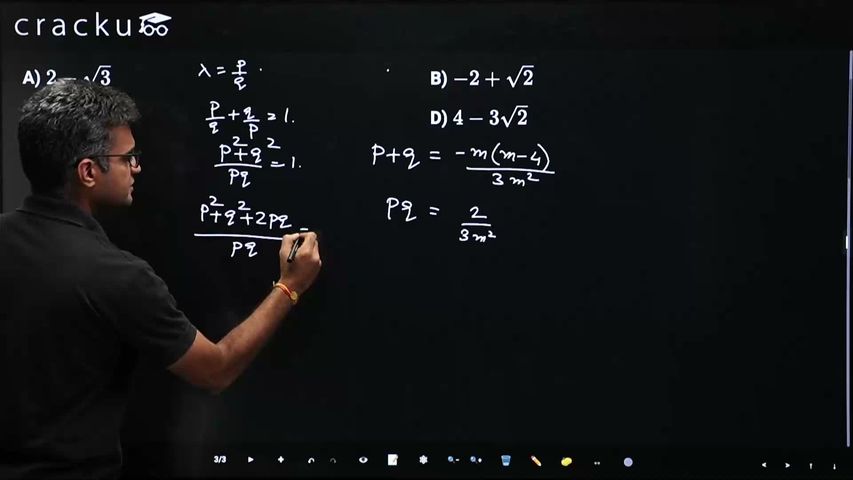
If $$\lambda$$ be the ratio of the roots of the quadratic equation in x, $$3m^2x^2 + m(m-4)x + 2 = 0$$, then the least value of m for which $$\lambda + \frac{1}{\lambda} = 1$$, is:
We are given the quadratic equation in the variable $$x$$
$$3m^{2}x^{2}+m(m-4)x+2=0$$
Let the two (non-zero) roots of this equation be $$\alpha$$ and $$\beta$$. Their ratio is denoted by $$\lambda$$, so we write
$$\lambda=\dfrac{\alpha}{\beta}\qquad\Longrightarrow\qquad \lambda+\dfrac1{\lambda}=\dfrac{\alpha}{\beta}+\dfrac{\beta}{\alpha} =\dfrac{\alpha^{2}+\beta^{2}}{\alpha\beta}.$$
The sum and product of the roots of any quadratic $$ax^{2}+bx+c=0$$ are given by the standard relations
$$\alpha+\beta=-\dfrac{b}{a},\qquad \alpha\beta=\dfrac{c}{a}.$$
For our quadratic we have the coefficients
$$a=3m^{2},\qquad b=m(m-4)=m^{2}-4m,\qquad c=2.$$
Therefore
$$\alpha+\beta=-\dfrac{m^{2}-4m}{3m^{2}} =\dfrac{4m-m^{2}}{3m^{2}},$$
$$\alpha\beta=\dfrac{2}{3m^{2}}.$$
To express $$\lambda+\dfrac1{\lambda}$$ in terms of the symmetric functions, first note the algebraic identity
$$\alpha^{2}+\beta^{2}=(\alpha+\beta)^{2}-2\alpha\beta.$$
Using this, we obtain
$$\lambda+\dfrac{1}{\lambda} =\dfrac{\alpha^{2}+\beta^{2}}{\alpha\beta} =\dfrac{(\alpha+\beta)^{2}-2\alpha\beta}{\alpha\beta}.$$
The condition given in the question is
$$\lambda+\dfrac1{\lambda}=1.$$
Substituting the above expression, we get
$$\dfrac{(\alpha+\beta)^{2}-2\alpha\beta}{\alpha\beta}=1.$$
Multiplying both sides by $$\alpha\beta$$ yields
$$(\alpha+\beta)^{2}-2\alpha\beta=\alpha\beta,$$ so that
$$(\alpha+\beta)^{2}=3\alpha\beta.$$
Now we substitute the explicit values of $$\alpha+\beta$$ and $$\alpha\beta$$ obtained from the coefficients.
First compute the square of the sum:
$$(\alpha+\beta)^{2} =\left(\dfrac{4m-m^{2}}{3m^{2}}\right)^{2} =\dfrac{(4m-m^{2})^{2}}{9m^{4}} =\dfrac{m^{2}(4-m)^{2}}{9m^{4}} =\dfrac{(4-m)^{2}}{9m^{2}}.$$
The product is
$$\alpha\beta=\dfrac{2}{3m^{2}}.$$
Setting $$(\alpha+\beta)^{2}=3\alpha\beta$$ gives
$$\dfrac{(4-m)^{2}}{9m^{2}}=3\left(\dfrac{2}{3m^{2}}\right).$$
Simplifying the right-hand side:
$$3\left(\dfrac{2}{3m^{2}}\right)=\dfrac{2}{m^{2}}.$$
Hence we have
$$\dfrac{(4-m)^{2}}{9m^{2}}=\dfrac{2}{m^{2}}.$$
Because $$m\neq0$$, the factors $$m^{2}$$ cancel out, leaving
$$(4-m)^{2}=18.$$
Taking square roots on both sides,
$$4-m=\pm\sqrt{18}=\pm3\sqrt{2}.$$
Thus the possible values of $$m$$ are
$$m=4-3\sqrt{2}\quad\text{or}\quad m=4+3\sqrt{2}.$$
Among these, the least value is clearly
$$m=4-3\sqrt{2}.$$
This value exactly matches option D in the list provided.
Hence, the correct answer is Option D.
Was this solution helpful?
Click on the Email ☝️ to Watch the Video Solution
Create a FREE account and get:
_1.webp)

Educational materials for JEE preparation

Ask our AI anything

AI can make mistakes. Please verify important information.
AI can make mistakes. Please verify important information.
