
Join Our JEE Preparation Group
Prep with like-minded aspirants; Get access to free daily tests and study material.
Sign in
Please select an account to continue using cracku.in
↓ →
Join Our JEE Preparation Group
Prep with like-minded aspirants; Get access to free daily tests and study material.
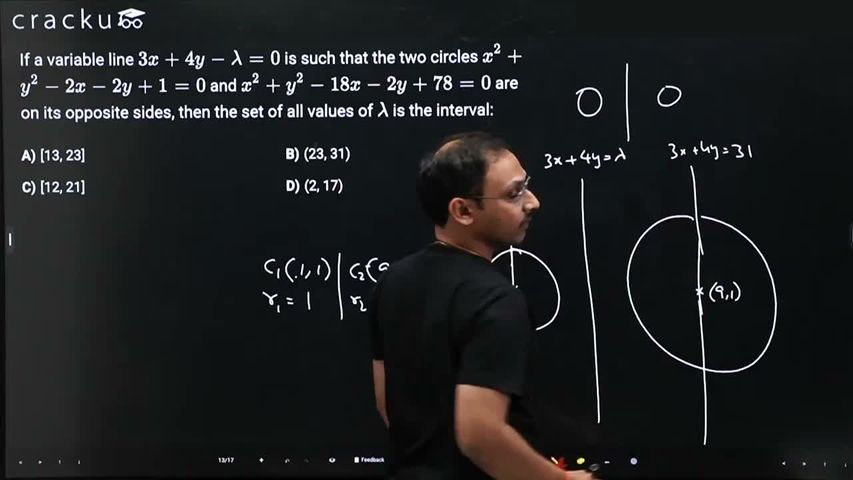
If a variable line $$3x + 4y - \lambda = 0$$ is such that the two circles $$x^2 + y^2 - 2x - 2y + 1 = 0$$ and $$x^2 + y^2 - 18x - 2y + 78 = 0$$ are on its opposite sides, then the set of all values of $$\lambda$$ is the interval:
We have the family of straight lines given by $$3x+4y-\lambda=0.$$ To decide whether the two given circles lie on opposite sides of any one member of this family, we proceed in three clear stages: first locate the centres of the circles, next examine the sign of the linear expression at those centres, and finally make sure that the whole of each circle (and not merely its centre) remains on one side of the line.
The first circle is
$$x^{2}+y^{2}-2x-2y+1=0.$$
Writing it in the completed-square form,
$$x^{2}-2x+1+y^{2}-2y+1=1-1,$$ $$\bigl(x-1\bigr)^{2}+\bigl(y-1\bigr)^{2}=1.$$ So its centre is $$C_{1}(1,1)$$ and its radius is $$r_{1}=1.$$
The second circle is
$$x^{2}+y^{2}-18x-2y+78=0.$$
Again completing the squares,
$$x^{2}-18x+81+y^{2}-2y+1 = -78+81+1,$$ $$\bigl(x-9\bigr)^{2}+\bigl(y-1\bigr)^{2}=4.$$ Hence its centre is $$C_{2}(9,1)$$ and its radius is $$r_{2}=2.$$
For any point $$(x_{0},y_{0})$$ the signed value of the linear expression is simply $$S(x_{0},y_{0})=3x_{0}+4y_{0}-\lambda.$$
Evaluating this at the two centres gives
$$S_{1}=S(C_{1}) = 3\cdot1 + 4\cdot1 - \lambda = 7-\lambda,$$ $$S_{2}=S(C_{2}) = 3\cdot9 + 4\cdot1 - \lambda = 31-\lambda.$$
For the two centres to be on opposite sides of the line, these signed values must have opposite signs, i.e.
$$(7-\lambda)(31-\lambda)\lt 0.$$
The quadratic expression above changes sign exactly at its roots $$\lambda=7$$ and $$\lambda=31.$$ Since its leading coefficient is positive, the product is negative strictly between the roots. Therefore
$$7\lt \lambda\lt 31. \quad -(1)$$
However, the condition that the entire circle lies on one side of the line is a little stronger than the mere condition on its centre. The perpendicular distance of a point $$(x_{0},y_{0})$$ from the line $$3x+4y-\lambda=0$$ is, by the distance formula,
$$d=\frac{|3x_{0}+4y_{0}-\lambda|}{\sqrt{3^{2}+4^{2}}}= \frac{|3x_{0}+4y_{0}-\lambda|}{5}.$$
For the whole of each circle to be on one side, we must have
$$d\;\ge\;\text{radius}.$$
Applying this to the first circle:
$$\frac{|7-\lambda|}{5}\;\ge\;1 \quad\Longrightarrow\quad |7-\lambda|\;\ge\;5.$$
Since (1) already tells us $$\lambda\gt 7$$, the absolute value can be dropped in favour of the positive branch:
$$\lambda-7\;\ge\;5 \quad\Longrightarrow\quad \lambda\;\ge\;12. \quad -(2)$$
Now apply the distance condition to the second circle:
$$\frac{|31-\lambda|}{5}\;\ge\;2 \quad\Longrightarrow\quad |31-\lambda|\;\ge\;10.$$
Because (1) also gives $$\lambda\lt 31$$, the absolute value resolves to the positive quantity $$(31-\lambda)$$, giving
$$31-\lambda\;\ge\;10 \quad\Longrightarrow\quad \lambda\;\le\;21. \quad -(3)$$
Combining the three requirements (1), (2) and (3) we obtain
$$12\;\le\;\lambda\;\le\;21.$$
Thus the permissible set of $$\lambda$$ values is the closed interval $$[12,\,21].$$
Hence, the correct answer is Option C.
Was this solution helpful?
Click on the Email ☝️ to Watch the Video Solution
Create a FREE account and get:
Educational materials for JEE preparation

Ask our AI anything

AI can make mistakes. Please verify important information.
AI can make mistakes. Please verify important information.

_1.webp)
