
Join Our JEE Preparation Group
Prep with like-minded aspirants; Get access to free daily tests and study material.
Sign in
Please select an account to continue using cracku.in
↓ →
Join Our JEE Preparation Group
Prep with like-minded aspirants; Get access to free daily tests and study material.
A point source of light, S is placed at a distance L in front of the center of plane mirror of width d which is hanging vertically on a wall. A man walks in front of the mirror along a line parallel to the mirror, at a distance 2L as shown below. The distance over which the man can see the image of the light source in the mirror is:
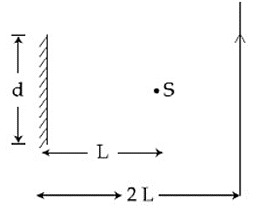
Let the source S be placed at a distance L from the mirror. Its virtual image I forms behind the mirror at an equal distance L
The man walks along a line parallel to the mirror at a total distance of 2L from the mirror.
$$\text{Therefore, the perpendicular distance from the virtual image } I \text{ to the man's path is: } $$
$$D = L + 2L = 3L$$
Let $$y$$ be the maximum vertical distance (field of view width) over which the reflected rays spread on the walking path.
By matching the similar triangles formed by the virtual image I with the mirror width d and the walking path width y:
$$\frac{\text{Width of walking path region }(y)}{\text{Width of mirror }(d)} = \frac{\text{Distance from image } I \text{ to the path}}{\text{Distance from image } I \text{ to the mirror}}$$
$$\frac{y}{d} = \frac{3L}{L} \implies y = 3d$$
Was this solution helpful?
Create a FREE account and get:
_1.webp)

Educational materials for JEE preparation

Ask our AI anything

AI can make mistakes. Please verify important information.
AI can make mistakes. Please verify important information.
