
Join Our JEE Preparation Group
Prep with like-minded aspirants; Get access to free daily tests and study material.
Sign in
Please select an account to continue using cracku.in
↓ →
Join Our JEE Preparation Group
Prep with like-minded aspirants; Get access to free daily tests and study material.
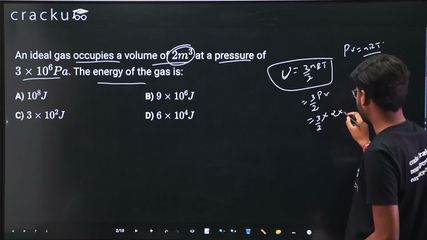
An ideal gas occupies a volume of $$2 m^3$$ at a pressure of $$3 \times 10^6 Pa$$. The energy of the gas is:
The problem speaks about an ideal gas, so we recall the relationship between the internal energy $$U$$ of an ideal, mono-atomic gas and its state variables. For such a gas, the internal energy depends only on temperature and is given by the well-known formula
$$U \;=\; \frac{3}{2}\,nRT.$$
Here $$nRT$$ can be replaced by $$PV$$ through the ideal-gas equation $$PV=nRT$$. Substituting $$nRT=PV$$ into the expression for $$U$$, we arrive at
$$U \;=\; \frac{3}{2}\,PV.$$
Now we insert the numerical values supplied in the question. The pressure is
$$P \;=\; 3 \times 10^{6}\ \text{Pa},$$
and the volume is
$$V \;=\; 2\ \text{m}^{3}.$$
First we form the product $$PV$$:
$$PV \;=\; \bigl(3 \times 10^{6}\ \text{Pa}\bigr)\,\bigl(2\ \text{m}^{3}\bigr) \;=\; 6 \times 10^{6}\ \text{Pa·m}^{3}.$$
The unit $$\text{Pa·m}^{3}$$ is equivalent to the joule, because $$1\ \text{Pa}=1\ \text{N\,m}^{-2}$$ and $$1\ \text{N\,m}=1\ \text{J}$$. Hence
$$PV \;=\; 6 \times 10^{6}\ \text{J}.$$
Next we multiply by $$\dfrac{3}{2}$$ as demanded by the formula for internal energy:
$$U \;=\; \frac{3}{2}\,\bigl(6 \times 10^{6}\ \text{J}\bigr) \;=\; 3 \times 10^{6}\ \text{J} \times 1.5 \;=\; 9 \times 10^{6}\ \text{J}.$$
Thus the energy of the gas is $$9 \times 10^{6}\ \text{J}.$$
Hence, the correct answer is Option B.
Was this solution helpful?
Click on the Email ☝️ to Watch the Video Solution
Create a FREE account and get:
_1.webp)

Educational materials for JEE preparation

Ask our AI anything

AI can make mistakes. Please verify important information.
AI can make mistakes. Please verify important information.
