
Join Our JEE Preparation Group
Prep with like-minded aspirants; Get access to free daily tests and study material.
Sign in
Please select an account to continue using cracku.in
↓ →
Join Our JEE Preparation Group
Prep with like-minded aspirants; Get access to free daily tests and study material.
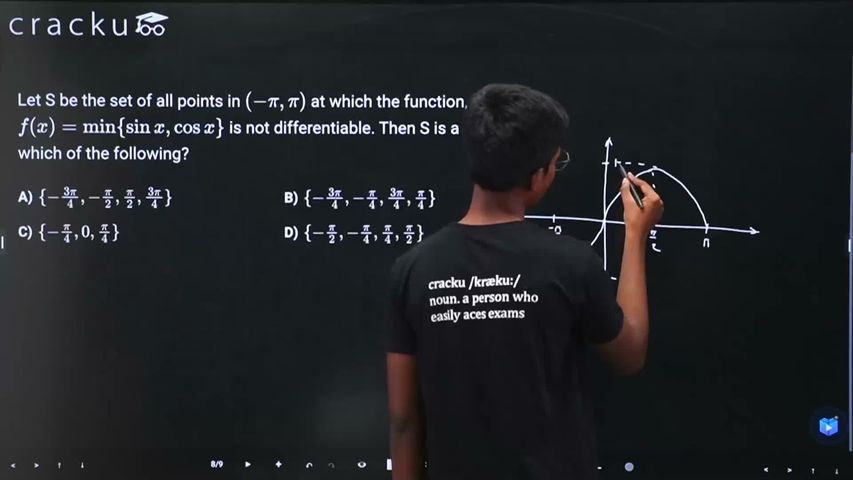
Let S be the set of all points in $$(-\pi, \pi)$$ at which the function, $$f(x) = \min\{\sin x, \cos x\}$$ is not differentiable. Then S is a subset of which of the following?
We have the function $$f(x)=\min\{\sin x,\; \cos x\}$$ defined for all $$x\in(-\pi,\pi)$$. For a function that is the minimum of two differentiable functions, the only possible points of non-differentiability are
1. the points where the two component functions themselves fail to be differentiable, and
2. the points where the two component functions are equal, because at such points the “smaller” branch may switch from one function to the other, creating a corner.
First, both $$\sin x$$ and $$\cos x$$ are differentiable everywhere on $$(-\pi,\pi)$$, so case 1 gives no new points. Hence we focus on case 2: points where $$\sin x=\cos x$$.
We solve $$\sin x=\cos x$$:
Divide both sides by $$\cos x$$ (which is non-zero except at isolated points where the equality is already false):
$$\frac{\sin x}{\cos x}=1 \;\;\Longrightarrow\;\; \tan x = 1.$$
The general solution of $$\tan x = 1$$ is
$$x=\frac{\pi}{4}+n\pi,\qquad n\in\mathbb Z.$$
We restrict to $$(-\pi,\pi)$$, so we list all integral values of $$n$$ that keep $$x$$ in this interval:
For $$n=0: \; x=\frac{\pi}{4}\;(\approx 0.785)$$ is inside the interval.
For $$n=-1: \; x=\frac{\pi}{4}-\pi=-\frac{3\pi}{4}\;(\approx -2.356)$$ is also inside the interval.
For $$n=1: \; x=\frac{\pi}{4}+\pi=\frac{5\pi}{4}\;(\approx 3.927)$$ exceeds $$\pi$$, so it is excluded.
For $$n=-2: \; x=\frac{\pi}{4}-2\pi=-\frac{7\pi}{4}\;(\approx -5.498)$$ is less than $$-\pi$$, so it is also excluded.
Thus the only candidates are
$$x=-\frac{3\pi}{4}\quad\text{and}\quad x=\frac{\pi}{4}.$$
We must now check that the derivative really fails to exist at these points. To do so we examine the “active” branch of the minimum on either side of each point.
Choose a test point just to the left of $$\frac{\pi}{4}$$, say $$x=\frac{\pi}{4}-\varepsilon$$ with $$\varepsilon>0$$ very small:
$$\sin\!\Bigl(\frac{\pi}{4}-\varepsilon\Bigr)\;<\;\cos\!\Bigl(\frac{\pi}{4}-\varepsilon\Bigr)$$ (because near the origin $$\sin x<\cos x$$ and the inequality persists up to the equality point). Hence for $$x<\frac{\pi}{4}$$ we have $$f(x)=\sin x$$, whose derivative is $$f'(x)=\cos x$$.
Now pick a point just to the right, $$x=\frac{\pi}{4}+\varepsilon$$:
$$\sin\!\Bigl(\frac{\pi}{4}+\varepsilon\Bigr)\;>\;\cos\!\Bigl(\frac{\pi}{4}+\varepsilon\Bigr)$$ so for $$x>\frac{\pi}{4}$$ we have $$f(x)=\cos x$$, whose derivative is $$f'(x)=-\sin x$$.
Compute the one-sided derivatives at $$x=\frac{\pi}{4}$$:
Left derivative:
$$\lim_{\varepsilon\to0^+}\cos\!\Bigl(\frac{\pi}{4}-\varepsilon\Bigr)=\cos\!\Bigl(\frac{\pi}{4}\Bigr)=\frac{\sqrt{2}}{2}.$$ Right derivative:
$$\lim_{\varepsilon\to0^+}-\sin\!\Bigl(\frac{\pi}{4}+\varepsilon\Bigr)=-\sin\!\Bigl(\frac{\pi}{4}\Bigr)=-\frac{\sqrt{2}}{2}.$$
These two limits are not equal, so $$f(x)$$ is not differentiable at $$x=\dfrac{\pi}{4}$$. An identical calculation around $$x=-\dfrac{3\pi}{4}$$ shows:
Left derivative at $$x=-\dfrac{3\pi}{4}: \; \frac{\sqrt{2}}{2}$$, Right derivative at $$x=-\dfrac{3\pi}{4}: \; -\frac{\sqrt{2}}{2}$$,
again unequal, confirming non-differentiability there as well.
No other points in $$(-\pi,\pi)$$ make $$\sin x=\cos x$$, and since both component functions are differentiable everywhere, these two points are the entire set:
$$S=\Bigl\{-\frac{3\pi}{4},\; \frac{\pi}{4}\Bigr\}.$$
Now we compare this set with the options given. Option B lists
$$\Bigl\{-\frac{3\pi}{4},\; -\frac{\pi}{4},\; \frac{3\pi}{4},\; \frac{\pi}{4}\Bigr\},$$
which certainly contains both $$-\dfrac{3\pi}{4}$$ and $$\dfrac{\pi}{4}$$. None of the other options contain both of these numbers simultaneously. Therefore $$S$$ is a subset of the set in Option B.
Hence, the correct answer is Option B.
Was this solution helpful?
Click on the Email ☝️ to Watch the Video Solution
Create a FREE account and get:
_1.webp)

Educational materials for JEE preparation

Ask our AI anything

AI can make mistakes. Please verify important information.
AI can make mistakes. Please verify important information.
