Join Our JEE Preparation Group
Prep with like-minded aspirants; Get access to free daily tests and study material.
Sign in
Please select an account to continue using cracku.in
↓ →
Join Our JEE Preparation Group
Prep with like-minded aspirants; Get access to free daily tests and study material.
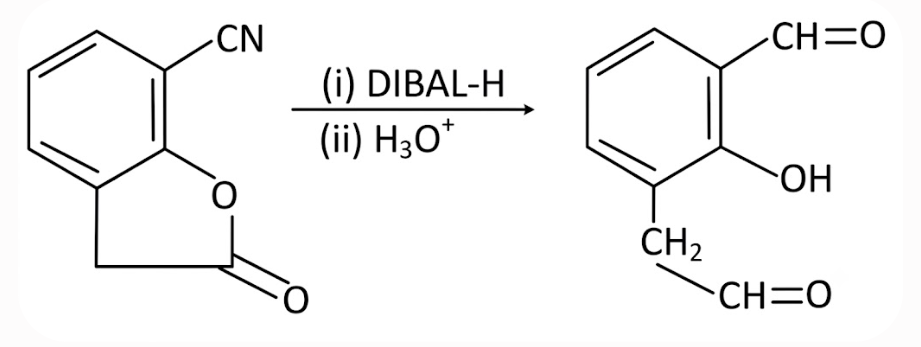
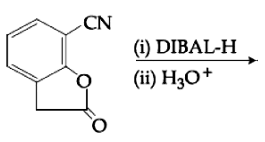
Reduction of the Nitrile Group ($$-\text{CN}$$):
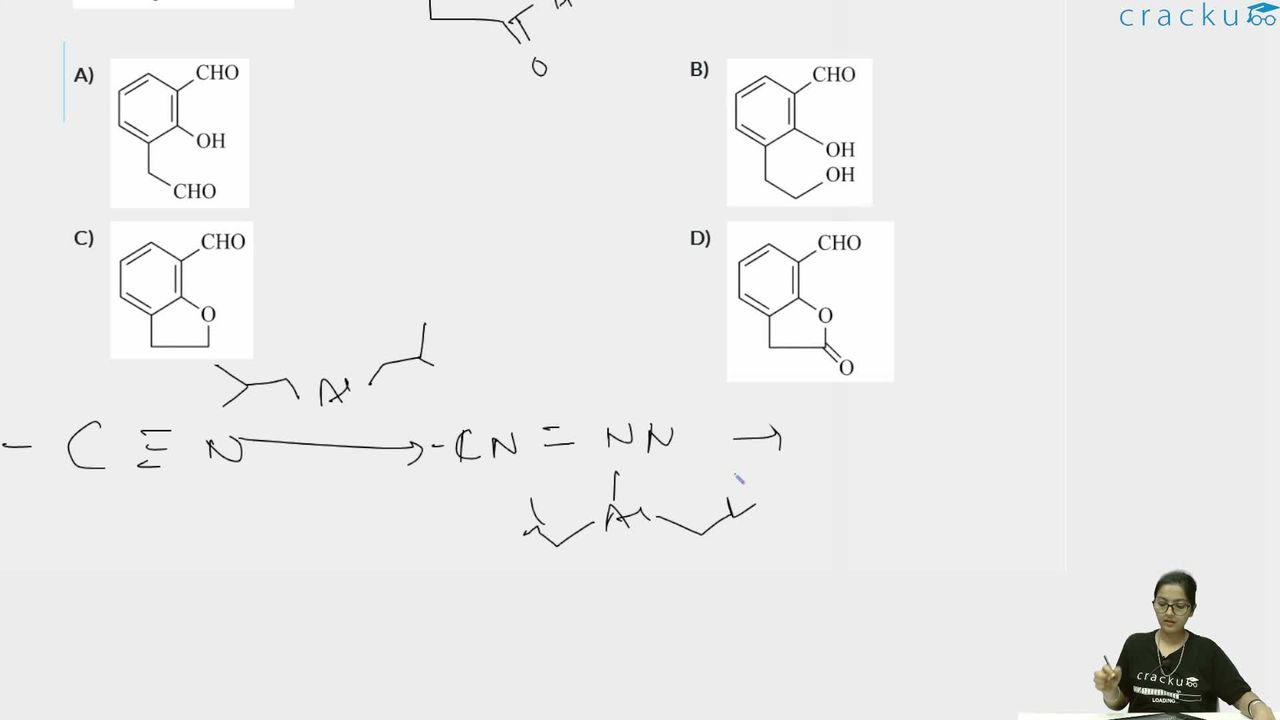
$$\text{DIBAL-H}$$ partially reduces the nitrile group attached to the aromatic ring into an imine intermediate. Upon subsequent acid hydrolysis ($$\text{H}_3\text{O}^\oplus$$), this imine is converted directly into a formyl group (aldehyde, $$-\text{CH}=\text{O}$$):
$$\text{Ar--C}\equiv\text{N} \xrightarrow{\text{(i) DIBAL-H}} \text{Ar--CH}=\text{NH} \xrightarrow{\text{(ii) H}_3\text{O}^\oplus} \text{Ar--CH}=\text{O}$$Reduction and Cleavage of the Lactone (Cyclic Ester):
$$\text{DIBAL-H}$$ also attacks the carbonyl carbon of the cyclic lactone ring, reducing it to a cyclic hemiacetal stage. During the acidic workup ($$\text{H}_3\text{O}^\oplus$$), this ring opens up completely to release a phenolic hydroxyl group ($$-\text{OH}$$) on the aromatic ring and a terminal aliphatic aldehyde group ($$-\text{CH}_2\text{CH}=\text{O}$$) on the side chain.
Both the nitrile and lactone functional groups are cleanly reduced by $$\text{DIBAL-H}$$ to yield a product containing a phenol and two distinct aldehyde functional groups.
Answer: Option A
Was this solution helpful?
Click on the Email ☝️ to Watch the Video Solution
Create a FREE account and get:
_1.webp)

Educational materials for JEE preparation

Ask our AI anything

AI can make mistakes. Please verify important information.
AI can make mistakes. Please verify important information.