Join Our JEE Preparation Group
Prep with like-minded aspirants; Get access to free daily tests and study material.
Sign in
Please select an account to continue using cracku.in
↓ →
Join Our JEE Preparation Group
Prep with like-minded aspirants; Get access to free daily tests and study material.
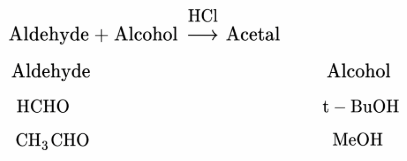
We recall the general acid-catalysed acetal formation:
$$\text{Aldehyde}(RCHO) + 2\,\text{Alcohol}(R'OH) \xrightarrow{HCl} RCH(OR')_2 + H_2O$$
The mechanism involves these key steps:
1. Protonation of the carbonyl oxygen to give a more electrophilic $$RCH^+=O$$ species.
2. Nucleophilic attack of the alcohol oxygen on the carbonyl carbon to form a hemiacetal.
3. Proton transfers followed by loss of water and a second alcohol attack to give the acetal.
The slow, rate-determining step is the nucleophilic attack of the alcohol on the protonated carbonyl carbon. Hence:
• The electrophile should be as reactive and as unhindered as possible.
• The nucleophile (alcohol) should be as unhindered and as nucleophilic as possible.
Reactivity order of carbonyl compounds toward nucleophilic addition is
$$\text{HCHO} \; \lt \; CH_3CHO \; \lt \; R_2C=O$$
but when we talk of ease of attack, “<” actually reads “less hindered & more reactive → reacts faster,” so
Formaldehyde (HCHO) > Acetaldehyde ($$\text{CH}_3\text{CHO}$$) > Ketones
Among alcohols, steric bulk decreases nucleophilicity:
MeOH (1°) > EtOH (1° larger) > 2° alcohols > t-BuOH (3°)
Now we examine each option.
A. Aldehyde = $$\text{HCHO}$$ (least hindered, most electrophilic); Alcohol = $$\text{MeOH}$$ (least hindered, most nucleophilic).
B. Aldehyde = $$CH_3CHO$$ (more hindered than HCHO); Alcohol = $$\text{t-BuOH}$$ (very hindered).
C. Aldehyde = $$CH_3CHO$$; Alcohol = $$\text{MeOH}$$ (good alcohol but aldehyde slightly less reactive).
D. Aldehyde = $$\text{HCHO}$$; Alcohol = $$\text{t-BuOH}$$ (excellent aldehyde but very poor, hindered alcohol).
Clearly, Option A combines the most electrophilic carbonyl with the most nucleophilic alcohol, minimising steric hindrance in both partners. This pair will give the fastest and highest-yielding acetal formation under $$HCl$$ catalysis.
Hence, the correct answer is Option A.
Was this solution helpful?
Create a FREE account and get:
_1.webp)

Educational materials for JEE preparation

Ask our AI anything

AI can make mistakes. Please verify important information.
AI can make mistakes. Please verify important information.