
Join Our JEE Preparation Group
Prep with like-minded aspirants; Get access to free daily tests and study material.
Sign in
Please select an account to continue using cracku.in
↓ →
Join Our JEE Preparation Group
Prep with like-minded aspirants; Get access to free daily tests and study material.
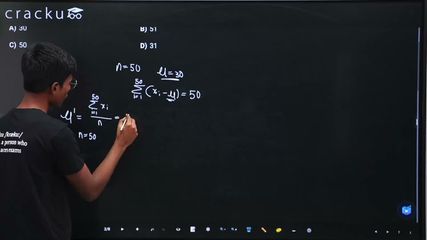
If the sum of the deviations of 50 observations from 30 is 50, then the mean of these observations is:
Let us denote the 50 observations by $$x_1,\,x_2,\,x_3,\ldots ,x_{50}$$ and let their arithmetic mean be $$\bar x$$.
We are told that the sum of the deviations of these observations from the number 30 is 50. Writing this information algebraically, we have
$$\displaystyle \sum_{i=1}^{50}(x_i-30)=50.$$
We expand the summation:
$$\sum_{i=1}^{50}(x_i-30)=\sum_{i=1}^{50}x_i-\sum_{i=1}^{50}30.$$
Because 30 is a constant, its sum over 50 terms is simply $$30\times50.$$ Therefore, the right-hand side becomes
$$\sum_{i=1}^{50}x_i-30\times50.$$
So the given equation can be rewritten as
$$\sum_{i=1}^{50}x_i-30\times50=50.$$
We now isolate the unknown sum $$\sum_{i=1}^{50}x_i$$:
$$\sum_{i=1}^{50}x_i=50+30\times50.$$
We calculate the product $$30\times50$$ first:
$$30\times50=1500.$$
Substituting this value back, we obtain
$$\sum_{i=1}^{50}x_i=50+1500.$$
Adding the two numbers gives
$$\sum_{i=1}^{50}x_i=1550.$$
Now, by the definition of the arithmetic mean,
$$\bar x=\frac{\sum_{i=1}^{50}x_i}{50}.$$
Substituting the sum we just found, we have
$$\bar x=\frac{1550}{50}.$$
We perform the division:
$$\bar x=31.$$
Hence, the mean of the 50 observations is $$31$$.
Hence, the correct answer is Option D.
Was this solution helpful?
Click on the Email ☝️ to Watch the Video Solution
Create a FREE account and get:
_1.webp)

Educational materials for JEE preparation

Ask our AI anything

AI can make mistakes. Please verify important information.
AI can make mistakes. Please verify important information.
