NTA JEE Main 29th July 2022 Shift 2
For the following questions answer them individually
NTA JEE Main 29th July 2022 Shift 2 - Question 11
Two identical thin metal plates has charge $$q_1$$ and $$q_2$$ respectively such that $$q_1 > q_2$$. The plates were brought close to each other to form a parallel plate capacitor of capacitance C. The potential difference between them is:
NTA JEE Main 29th July 2022 Shift 2 - Question 12
Given below are two statements: one is labelled as Assertion A and the other is labelled as Reason R.
Assertion A: Alloys such as constantan and manganin are used in making standard resistance coils.
Reason R: Constantan and manganin have very small value of temperature coefficient of resistance.
In the light of the above statements, choose the correct answer from the options given below.
NTA JEE Main 29th July 2022 Shift 2 - Question 13
A 1 m long wire is broken into two unequal parts X and Y. The X part of the wire is stretched into another wire W. Length of W is twice the length of X and the resistance of W is twice that of Y. Find the ratio of length of X and Y.

NTA JEE Main 29th July 2022 Shift 2 - Question 14
The vertical component of the earth's magnetic field is $$6 \times 10^{-5}$$ T at any place where the angle of dip is 37°. The earth's resultant magnetic field at that place will be (Given tan 37° = 3/4)
NTA JEE Main 29th July 2022 Shift 2 - Question 15
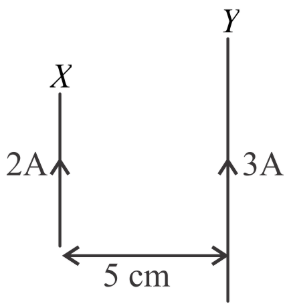
A wire X of length 50 cm carrying a current of 2 A is placed parallel to a long wire Y of length 5 m. The wire Y carries a current of 3 A. The distance between two wires is 5 cm and currents flow in the same direction. The force acting on the wire Y is:
NTA JEE Main 29th July 2022 Shift 2 - Question 16
A circuit element X when connected to an AC supply of peak voltage 100 V gives a peak current of 5 A which is in phase with the voltage. A second element Y when connected to the same AC supply also gives the same value of peak current which lags behind the voltage by $$\frac{\pi}{2}$$. If X and Y are connected in series to the same supply, what will be the rms value of the current in ampere?
NTA JEE Main 29th July 2022 Shift 2 - Question 17
Light enters from air into a given medium at an angle of 45° with interface of the air-medium surface. After refraction, the light ray is deviated through an angle of 15° from its original direction. The refractive index of the medium is:
NTA JEE Main 29th July 2022 Shift 2 - Question 18
An unpolarised light beam of intensity $$2I_0$$ is passed through a polaroid P and then through another polaroid Q which is oriented in such a way that its passing axis makes an angle of 30° relative to that of P. The intensity of the emergent light is
NTA JEE Main 29th July 2022 Shift 2 - Question 19
An $$\alpha$$ particle and a proton are accelerated from rest through the same potential difference. The ratio of linear momenta acquired by above two particles will be:
NTA JEE Main 29th July 2022 Shift 2 - Question 20
Read the following statements:
(A) Volume of the nucleus is directly proportional to the mass number.
(B) Volume of the nucleus is independent of mass number.
(C) Density of the nucleus is directly proportional to the mass number.
(D) Density of the nucleus is directly proportional to the cube root of the mass number.
(E) Density of the nucleus is independent of the mass number.
Choose the correct option from the following options.