
Join Our JEE Preparation Group
Prep with like-minded aspirants; Get access to free daily tests and study material.
Sign in
Please select an account to continue using cracku.in
↓ →
Join Our JEE Preparation Group
Prep with like-minded aspirants; Get access to free daily tests and study material.
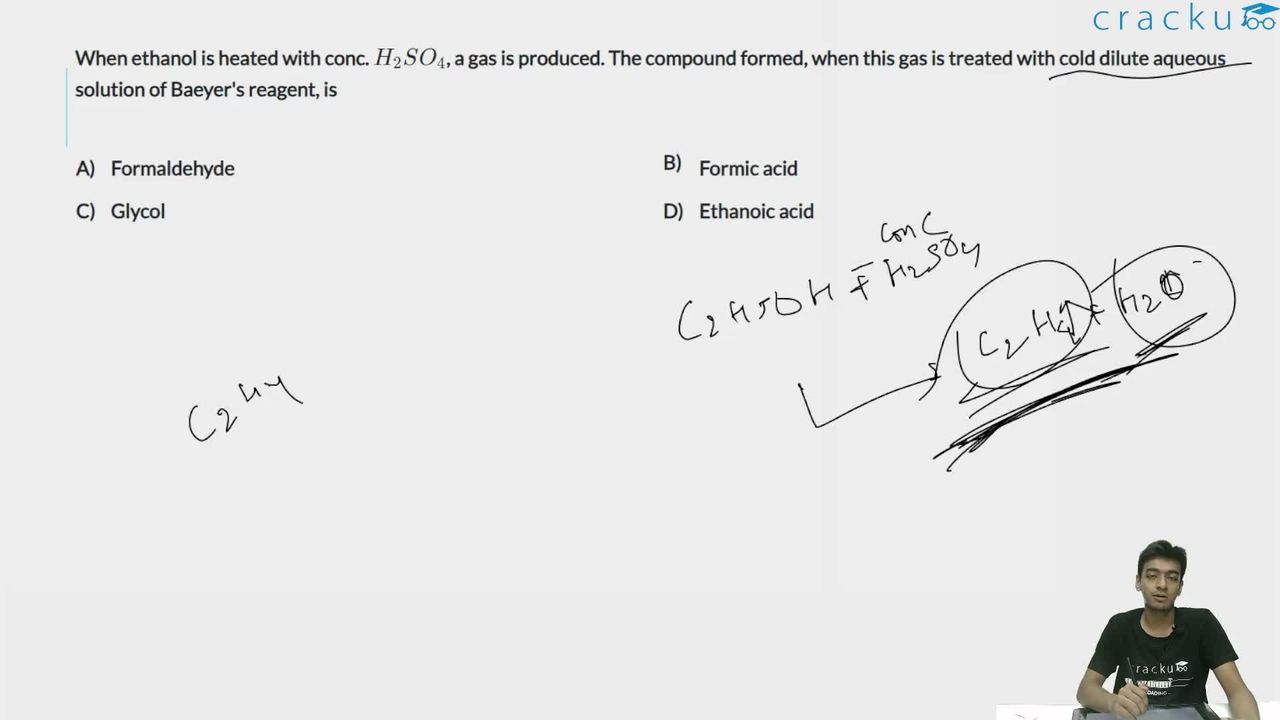
When ethanol is heated with conc. $$H_2SO_4$$, a gas is produced. The compound formed, when this gas is treated with cold dilute aqueous solution of Baeyer's reagent, is
When ethanol is heated with concentrated sulfuric acid, it undergoes dehydration. Dehydration is a reaction where a molecule loses water. The reaction for ethanol with concentrated sulfuric acid is:
First, ethanol has the formula CH₃CH₂OH. Concentrated sulfuric acid acts as a dehydrating agent and removes a water molecule. The reaction is:
$$ CH_{3}CH_{2}OH ->[conc. H_{2}SO_{4}][heat] CH_{2}=CH_{2} + H_{2}O $$
So, ethanol (CH₃CH₂OH) loses a water molecule (H₂O) to form ethene gas (CH₂=CH₂). Therefore, the gas produced is ethene.
Now, this gas (ethene) is treated with cold dilute aqueous solution of Baeyer's reagent. Baeyer's reagent is an alkaline solution of potassium permanganate (KMnO₄). It is used to test for unsaturation in organic compounds. When an alkene like ethene is treated with cold dilute Baeyer's reagent, it undergoes hydroxylation. Hydroxylation adds hydroxyl groups (-OH) across the double bond.
The reaction for ethene with Baeyer's reagent is:
$$ CH_{2}=CH_{2} + [O] + H_{2}O ->[cold, dil. KMnO_{4}] HO-CH_{2}-CH_{2}-OH $$
Here, [O] represents the oxidizing agent (from KMnO₄). The product is ethane-1,2-diol, commonly known as ethylene glycol or simply glycol. Its formula is HO-CH₂-CH₂-OH.
Therefore, the compound formed is glycol.
Now, looking at the options:
A. Formaldehyde (HCHO)
B. Formic acid (HCOOH)
C. Glycol (HOCH₂CH₂OH)
D. Ethanoic acid (CH₃COOH)
Option C matches the compound formed, which is glycol.
Hence, the correct answer is Option C.
Was this solution helpful?
Click on the Email ☝️ to Watch the Video Solution
Create a FREE account and get:
_1.webp)

Educational materials for JEE preparation

Ask our AI anything

AI can make mistakes. Please verify important information.
AI can make mistakes. Please verify important information.
