
Join Our JEE Preparation Group
Prep with like-minded aspirants; Get access to free daily tests and study material.
Sign in
Please select an account to continue using cracku.in
↓ →
Join Our JEE Preparation Group
Prep with like-minded aspirants; Get access to free daily tests and study material.
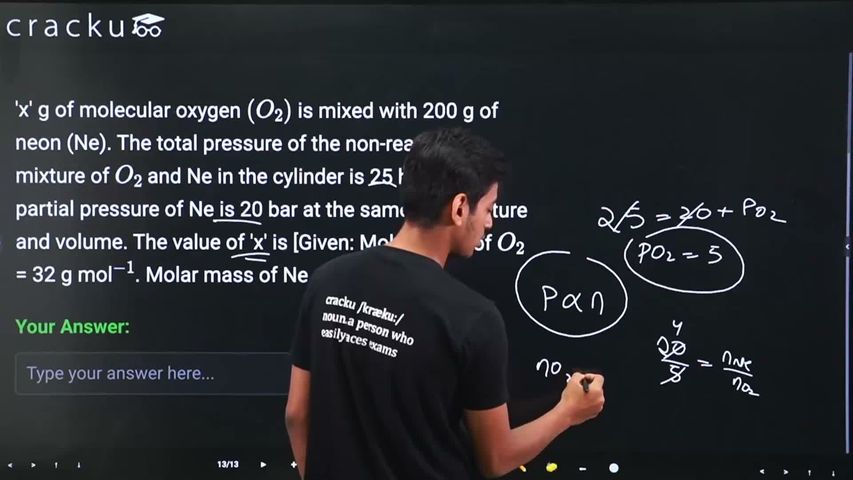
'x' g of molecular oxygen $$(O_2)$$ is mixed with 200 g of neon (Ne). The total pressure of the non-reactive mixture of $$O_2$$ and Ne in the cylinder is 25 bar. The partial pressure of Ne is 20 bar at the same temperature and volume. The value of 'x' is [Given: Molar mass of $$O_2$$ = 32 g mol$$^{-1}$$. Molar mass of Ne = 20 g mol$$^{-1}$$]
Correct Answer: 80
We have 'x' g of $$O_2$$ mixed with 200 g of Ne in a cylinder. The total pressure is 25 bar and the partial pressure of Ne is 20 bar. We need to find x.
By Dalton's law of partial pressures, the total pressure equals the sum of partial pressures:
$$P_{total} = P_{Ne} + P_{O_2}$$
$$25 = 20 + P_{O_2}$$
$$P_{O_2} = 5 \text{ bar}$$
Now, the partial pressure of a gas is related to its mole fraction by $$P_i = \chi_i \times P_{total}$$. We can also write the ratio of partial pressures:
$$\frac{P_{O_2}}{P_{Ne}} = \frac{n_{O_2}}{n_{Ne}}$$
We first find the moles of Ne. With 200 g of Ne and molar mass 20 g/mol:
$$n_{Ne} = \frac{200}{20} = 10 \text{ mol}$$
Now using the pressure ratio:
$$\frac{5}{20} = \frac{n_{O_2}}{10}$$
$$n_{O_2} = \frac{5 \times 10}{20} = 2.5 \text{ mol}$$
The mass of $$O_2$$ is:
$$x = n_{O_2} \times M_{O_2} = 2.5 \times 32 = 80 \text{ g}$$
Hence, the correct answer is 80.
Was this solution helpful?
Click on the Email ☝️ to Watch the Video Solution
Create a FREE account and get:
_1.webp)

Educational materials for JEE preparation

Ask our AI anything

AI can make mistakes. Please verify important information.
AI can make mistakes. Please verify important information.
