
Join Our JEE Preparation Group
Prep with like-minded aspirants; Get access to free daily tests and study material.
Sign in
Please select an account to continue using cracku.in
↓ →
Join Our JEE Preparation Group
Prep with like-minded aspirants; Get access to free daily tests and study material.
Consider, $$PF_5, BrF_5, PCl_3, SF_6, ICl_4^-, ClF_3$$ and $$IF_5$$. Amongst the above molecule(s)/ion(s), the number of molecule(s)/ion(s) having $$sp^3d^2$$ hybridisation is
Correct Answer: 4
We need to determine how many of the given species — $$PF_5$$, $$BrF_5$$, $$PCl_3$$, $$SF_6$$, $$ICl_4^-$$, $$ClF_3$$, and $$IF_5$$ — have $$sp^3d^2$$ hybridisation.
We determine the hybridisation of each species by counting the number of electron domains (bond pairs + lone pairs) around the central atom using the steric number.
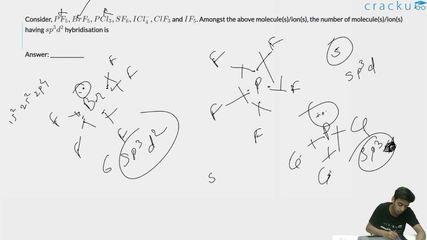
$$PF_5$$: Phosphorus has 5 bond pairs and 0 lone pairs, giving a steric number of 5. This corresponds to $$sp^3d$$ hybridisation (trigonal bipyramidal geometry). Not $$sp^3d^2$$.
$$BrF_5$$: Bromine has 7 valence electrons; 5 are used for bonding with fluorine, and 1 lone pair remains. The steric number is 5 + 1 = 6, which corresponds to $$sp^3d^2$$ hybridisation (square pyramidal geometry). This is $$sp^3d^2$$.
$$PCl_3$$: Phosphorus has 3 bond pairs and 1 lone pair, giving a steric number of 4. This is $$sp^3$$ hybridisation (trigonal pyramidal). Not $$sp^3d^2$$.
$$SF_6$$: Sulphur has 6 bond pairs and 0 lone pairs, giving a steric number of 6. This is $$sp^3d^2$$ hybridisation (octahedral geometry). This is $$sp^3d^2$$.
$$ICl_4^-$$: Iodine has 7 valence electrons plus 1 from the negative charge = 8. Four are used for bonding with Cl, leaving 2 lone pairs. The steric number is 4 + 2 = 6, which is $$sp^3d^2$$ hybridisation (square planar geometry). This is $$sp^3d^2$$.
$$ClF_3$$: Chlorine has 7 valence electrons; 3 are used for bonding with fluorine, leaving 2 lone pairs. The steric number is 3 + 2 = 5, which is $$sp^3d$$ hybridisation (T-shaped geometry). Not $$sp^3d^2$$.
$$IF_5$$: Iodine has 7 valence electrons; 5 are used for bonding with fluorine, leaving 1 lone pair. The steric number is 5 + 1 = 6, which is $$sp^3d^2$$ hybridisation (square pyramidal geometry). This is $$sp^3d^2$$.
The species with $$sp^3d^2$$ hybridisation are: $$BrF_5$$, $$SF_6$$, $$ICl_4^-$$, and $$IF_5$$. That gives us a count of 4.
Hence, the correct answer is 4.
Was this solution helpful?
Click on the Email ☝️ to Watch the Video Solution
Create a FREE account and get:
_1.webp)

Educational materials for JEE preparation

Ask our AI anything

AI can make mistakes. Please verify important information.
AI can make mistakes. Please verify important information.
