
Join Our JEE Preparation Group
Prep with like-minded aspirants; Get access to free daily tests and study material.
Sign in
Please select an account to continue using cracku.in
↓ →
Join Our JEE Preparation Group
Prep with like-minded aspirants; Get access to free daily tests and study material.
Assuming 1 $$\mu$$g of trace radioactive element X with a half life of 30 years is absorbed by a growing tree. The amount of X remaining in the tree after 100 years is _____ $$\times 10^{-1}$$ $$\mu$$g. [Given: $$\ln 10 = 2.303$$; $$\log 2 = 0.30$$]
Correct Answer: 1
We have 1 $$\mu$$g of radioactive element X with a half-life of 30 years, and we need to find the amount remaining after 100 years, expressed as $$\_\_\_ \times 10^{-1}$$ $$\mu$$g.
We use the radioactive decay formula:
$$N = N_0 \times e^{-\lambda t}$$
where $$\lambda = \frac{0.693}{t_{1/2}} = \frac{0.693}{30}$$ per year. After $$t = 100$$ years:
$$N = 1 \times e^{-\frac{0.693}{30} \times 100} = e^{-\frac{69.3}{30}} = e^{-2.31}$$
Now we evaluate $$e^{-2.31}$$. We know that $$\ln 10 = 2.303$$, so $$e^{-2.303} = 10^{-1} = 0.1$$. Since $$2.31$$ is very close to $$2.303$$, we can use the given values more precisely.
Using the alternative form: $$N = N_0 \times \left(\frac{1}{2}\right)^{t/t_{1/2}} = 1 \times \left(\frac{1}{2}\right)^{100/30} = \left(\frac{1}{2}\right)^{10/3}$$
Taking logarithm: $$\log N = -\frac{10}{3} \times \log 2 = -\frac{10}{3} \times 0.30 = -1.0$$
Therefore $$N = 10^{-1.0} = 0.1$$ $$\mu$$g.
Expressing this as $$\_\_\_ \times 10^{-1}$$ $$\mu$$g, we get $$0.1 = 1 \times 10^{-1}$$ $$\mu$$g.
Hence, the correct answer is 1.
Was this solution helpful?
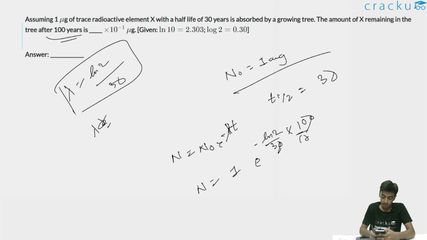
Click on the Email ☝️ to Watch the Video Solution
Create a FREE account and get:
_1.webp)

Educational materials for JEE preparation

Ask our AI anything

AI can make mistakes. Please verify important information.
AI can make mistakes. Please verify important information.
