
Join Our JEE Preparation Group
Prep with like-minded aspirants; Get access to free daily tests and study material.
Sign in
Please select an account to continue using cracku.in
↓ →
Join Our JEE Preparation Group
Prep with like-minded aspirants; Get access to free daily tests and study material.
Two bodies of masses $$m_1 = 5$$ kg and $$m_2 = 3$$ kg are connected by a light string going over a smooth light pulley on a smooth inclined plane as shown in the figure. The system is at rest. The force exerted by the inclined plane on the body of mass $$m_1$$ will be: [Take $$g = 10$$ m s$$^{-2}$$]
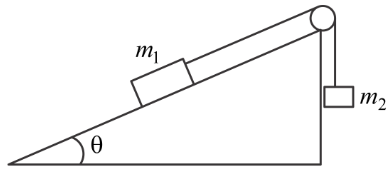
Now here we have 2 bodies of masses $$m_1$$ and $$m_2$$
Let us consider the forces acting on these
On $$m_2$$ the forces acting are $$T\ and\ F=\ m_2g$$
As they are in opposite directions and for the system to be in equilibrium, they have to be equal
$$T\ =\ m_2g$$
coming to the first body of mass $$m_1$$
Forces along the direction of incline are $$T\ and\ F_{ }=\ m_1g\sin\theta\ $$
These are also equal as the system is in equilibrium
So , $$T\ =m_1g\sin\theta\ $$
We know , $$T\ =\ m_2g$$
After Substituting T
$$m_1g\sin\theta\ =\ m_2g$$
$$5g\sin\theta\ =\ 3g$$
$$5\sin\theta\ =\ 3$$
$$\sin\theta\ =\ \frac{3}{5}$$
Now coming to Forces which are perpendicular to the incline
$$N\ and\ m_1g\cos\theta\ $$
Even they have to equal
so , $$N\ =\ m_1g\cos\theta\ $$
As $$\sin\theta\ =\frac{3}{5}\ then\ \cos\ \theta\ =\frac{4}{5}\ $$
Then $$N\ =\ m_1g\times\ \frac{4}{5}$$
$$N\ =5\times\ g\times\ \frac{4}{5}$$
$$N\ =5\times\ 10\times\ \frac{4}{5}$$
$$N\ =\ 10\times\ 4$$
$$N\ =\ 40N$$
This is the force exerted by the inclined plane on the body of mass $$m_1$$
Was this solution helpful?
Click on the Email ☝️ to Watch the Video Solution
Create a FREE account and get:
_1.webp)

Educational materials for JEE preparation

Ask our AI anything

AI can make mistakes. Please verify important information.
AI can make mistakes. Please verify important information.
