
Join Our JEE Preparation Group
Prep with like-minded aspirants; Get access to free daily tests and study material.
Sign in
Please select an account to continue using cracku.in
↓ →
Join Our JEE Preparation Group
Prep with like-minded aspirants; Get access to free daily tests and study material.
An object of mass 1 kg is taken to a height from the surface of earth which is equal to three times the radius of earth. The gain in potential energy of the object will be [If, $$g = 10$$ m s$$^{-2}$$ and radius of earth = 6400 km]
We have an object of mass $$m = 1$$ kg taken from the surface of the Earth to a height $$h = 3R$$, where $$R = 6400$$ km is the radius of the Earth.
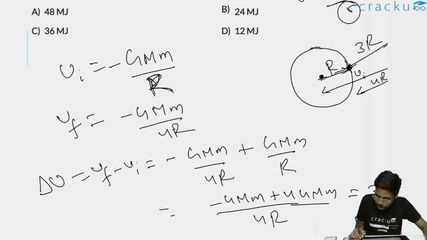
The gravitational potential energy at a distance $$r$$ from the centre of the Earth is $$U = -\frac{GMm}{r}$$. At the surface ($$r = R$$), the potential energy is $$U_i = -\frac{GMm}{R}$$. At height $$3R$$ above the surface ($$r = 4R$$), the potential energy is $$U_f = -\frac{GMm}{4R}$$.
The gain in potential energy is: $$\Delta U = U_f - U_i = -\frac{GMm}{4R} + \frac{GMm}{R} = \frac{GMm}{R}\left(1 - \frac{1}{4}\right) = \frac{3GMm}{4R}$$
Now, since $$g = \frac{GM}{R^2}$$, we have $$GM = gR^2$$. Substituting: $$\Delta U = \frac{3gR^2 m}{4R} = \frac{3}{4}mgR$$
Plugging in values: $$\Delta U = \frac{3}{4} \times 1 \times 10 \times 6400 \times 10^3 = \frac{3}{4} \times 64 \times 10^6 = 48 \times 10^6 \text{ J} = 48 \text{ MJ}$$.
Hence, the correct answer is Option 1.
Was this solution helpful?
Click on the Email ☝️ to Watch the Video Solution
Create a FREE account and get:
_1.webp)

Educational materials for JEE preparation

Ask our AI anything

AI can make mistakes. Please verify important information.
AI can make mistakes. Please verify important information.
